


As with Charlie Kirk, so with seemingly all high-profile shootings: Commentators swiftly discard official narratives of a “lone gunman” and, after the template established by the Kennedy assassination, claim that the shooting is impossible to explain without positing a wider plot of secret state-level actors.
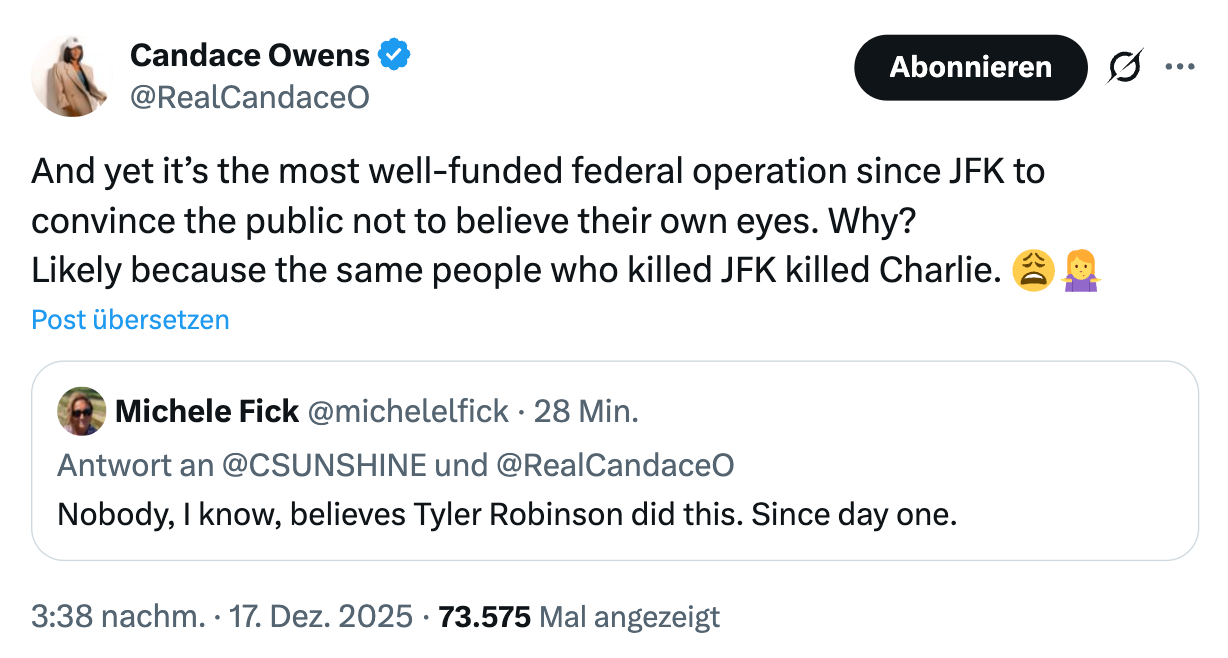
Candace Owens has dominated the Kirk conspiracy discourse. Her podcasts attract hundreds of thousands of live viewers and resonate across the entire internet. While she has yet to formulate a single, cohesive theory of Kirk’s death, Owens has disputed that Tyler Robinson acted alone, insisted that some foreign state actor (whether Israel, France or Egypt) may have been involved, and alternatively or simultaneously proposed that the assassination may have been coordinated within Kirk’s own organisation, Turning Point USA. Owens also alleged that the same network responsible for killing Kirk was also targeting her, that Kirk was likely killed “by the same people who killed JFK” and various other things that it is not worth my time to type or your time to read.
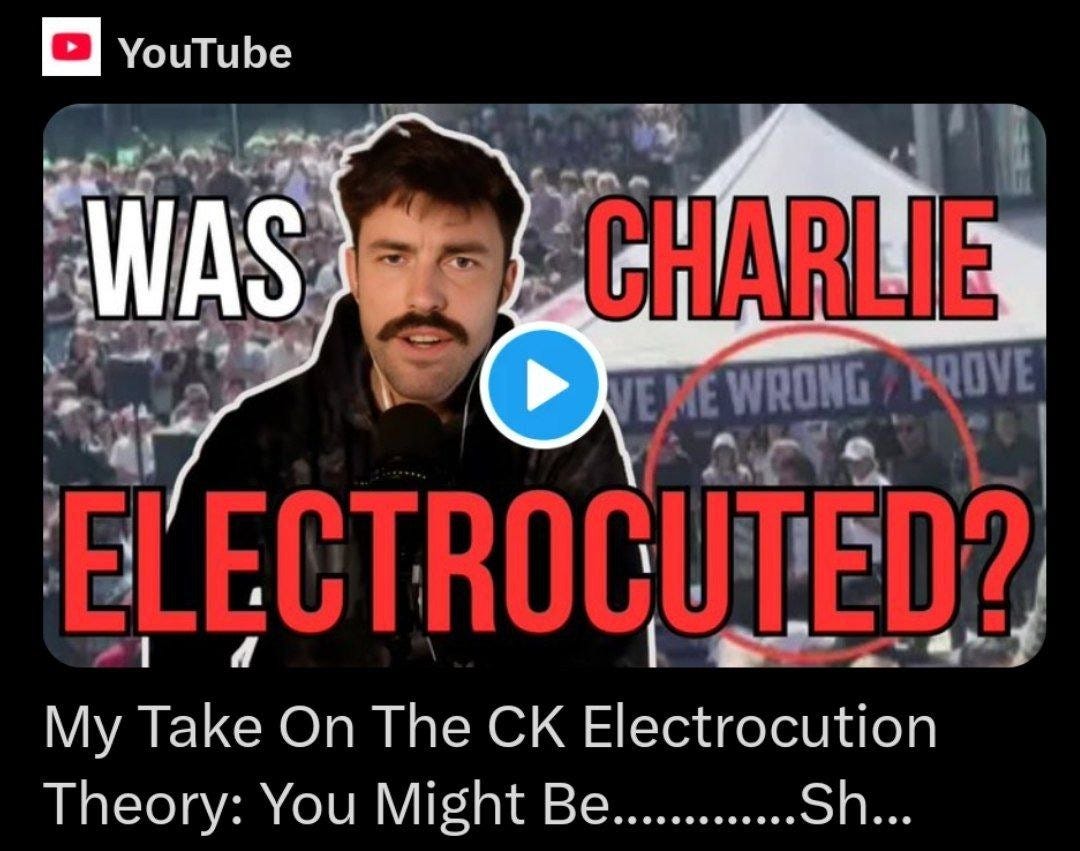
Owens has attracted an entire ecosystem of loosely aligned content creators who repeat and extend her speculations, often driving them into truly absurd territory. Here, for example, is Twitch streamer Ian Carroll entertaining the theory that Kirk might not have been shot, but rather electrocuted by a microphone:
I don’t want to say that the case against Robinson has no problems (no theory is perfect), but at its core it is compelling and politically explosive enough. Precisely as he was answering an audience question about transgender perpetrators of mass shootings, Kirk was shot to death by a young man with a transgender partner who had etched leftist slogans onto the cartridges of his bullets. Just three months later, however, outrage over this politically motivated killing has been redirected via Owens’s theories in all manner of new directions: against Israel, against the Trump administration, against Owens herself, against TP USA and Kirk’s former associates – against basically anyone and everyone except the one party most obviously to blame.
As I said, this happens with all major shootings, and with many other events besides. It is literally impossible for any high-profile personality to be shot without widespread scepticism that this “lone gunman” could have pulled off the crime and insistence that his deed must have been the fruit of some shadowy, sophisticated cabal. What is more, the various theories in this genre enjoy popularity with heavily overlapping audiences. Many people appear to believe that shooters working alone are just not a thing and that all major assassinations reflect conspiratorial plans.
These words will anger some readers, and no few will probably take to the comments to elucidate all of their reasons that I am wrong and they are right about this or that specific case. That’s fine, and anyway I’m not interested in the plausibility of any individual theory. We try not to waste our time debunking things here at the plague chronicle. Instead, I’m asking you to consider how reasonable this kind of discourse in general can actually be. Some things, after all, must surely happen more or less as the official narrative portrays them. Maybe even many things happen that way.
Now, silly discourse has always been with us, but my impression is that the intensity and appeal of these alternative theories have expanded massively in the past decade – even as the specific plausibility (and even the coherence) of these alternative interpretations has declined.
I know it is lame to blame the internet, but in this case it’s also unavoidable. To a large degree, this nonsense is a consequence of a tectonic shift in how we learn and communicate about the world. In 2005, internet penetration in the United States was only about 68%. Today, after the rise of smart phones and social media, it is well over 90%. Before 2010, the average internet user might have spent about five hours a week online; in 2025, that figure has risen to well over six hours per day across the West. This massive diversion of human attention to the online world is worth hundreds of billions in ad revenue alone, while content creators in Europe and North America pull in between 50 and 100 billion dollars every year. These figures make mobile-friendly, passive content like podcasting and streaming an economic force comparable to the entire world of book publishing or the music industry. That’s how big this is.
In just a few years, in other words, the creator economy has become a powerful cultural force, drawing energy away from other, more mainstream production and driving strange new phenomena like Paul Skallas’s “stuck culture.” It is especially important to get our heads around this development here on the right. The progressive media has abandoned this entire ideological sector and effectively gifted crazy internet people like me vast audiences. Unlike creators on the left, we need not coordinate our content with major press organs and many of us have enormous freedom to peddle whatever ideas we want.
The most successful social media personalities are experts at two things. To sell ads and conclude lucrative sponsorship deals, they must command and hold your attention. To expand their own reach, they must also drive engagement with their own content. When the news cycle commands a lot of attention organically, for example in an election year, doing both of these things at once can be quite easy, especially if you already have an established audience.
Particularly when the world of politics fails to generate fresh content and your followers’ attention begins to wander, the importance of what I call proprietary interpretations grows massively. Proprietary interpretations are takes, analyses and ideas that your readers can get only from you. They are your original content, the thing you have that other people don’t. And the sad truth is that originality is really hard. A lot of people independently arrive at the same roughly correct and predictive analyses, while your own viral insights are rare, dependent upon your specific expertise and impossible to call forth by a sheer effort of will.
Once you stop worrying about developing correct, defensible and predictive theories of the world, however, these constraints begin to vanish. You have much more freedom to craft proprietary interpretations that are designed, from the ground up, not to describe the world as it is, but solely to command attention and drive engagement.
It is important on the one hand to be controversial and outrageous; offending and irritating people will fill your replies like few other things. On the other hand, because you exist in a complex ecosystem of many other creators whose audiences overlap with yours, you want to avoid wandering onto falsifiable ground and also you probably shouldn’t produce detailed, coherent theories of anything, as these are likely to be incompatible with other theories your comrades in arms are promulgating alongside you. Thus we end up in this indefinite terrain, where we are always finding inconsistencies, noticing, asking questions, being open-minded and so on.
The failed Trump assassination and Kirk’s killing were both caught on video, and this fact paradoxically does not reduce the space to doubt official narratives, but rather opens a whole world of opportunities for contentious alternative analysis. The imagery confines the focus to small details and draws analysis away from the whole body of evidence. This narrow view of things is invariably used to exclude obvious explanations, which is the best way to create an enduring, impossible mystery. It’s an old tactic familiar from fields like true crime, where half or more of the most famous mysteries are actually fairly straightforward crimes made into insoluble tangles by the prior exclusion of an obviously guilty party. (The first, viral season of Sarah Koenig’s Serial podcast is an archetypal example here.)
Content creation, as an industry, is still in its infancy, and these arts are experiencing rapid development. Alex Jones was the first seriously successful social media personality to work in this style, but his successors – not just Owens, but many others too – have refined his approach and deepened the sophistication of his methods. In particular, they are much better at engineering their proprietary interpretations to cobble together larger audiences, for example by inserting Israel into the Kirk assassination story, in the hopes of tapping into the vast audience of pro-Palestinian Israel critics. Audience-building via invented analysis can be highly successful, but it has the simultaneous effect of dissipating political energy. We are just asking questions, but the answers never lead us in any coherent direction, because the audience for this stuff shares little common ground and drawing clear political conclusions would alienate too many supporters.
Asking whether any of these highly engineered and triangulated proprietary interpretations is true, or accurate, or informative, is almost the wrong question. They are very unlikely to be any of these things because that’s not their purpose. These proprietary takes are instead designed to engage broad audiences by simulating unique insight into hidden machinations. Doing this successfully can be worth millions of dollars, and a lot of very smart people spend their days thinking about how to tap into this growing market. The result is a world of constantly shifting, ephemeral, novelty-dependent theorising that entrances millions of people. That’s fine in itself, but what we lack – partly because this is a new field – is a broader cultural understanding that this is entertainment and very little of it is even intended to be accurate.
Another approach used is to deny that it actually happened. Following the mass shooting at Bondi Beach I received a link that led to an article claiming the whole thing was fake and set up by Israel to garner support.Many people are now very wary of MSM and don't know who to trust. I agree with your take but it is only part of a much bigger problem.
Candace Owens is a libelous grifter.