

Tomorrow, the citizens of Sachsen-Anhalt will engage in one of the most sacred political rituals known to man and elect a new state parliament. The German establishment is terrified of what these citizens might use this ritual to achieve, because Alternative für Deutschland is polling consistently above 40% in that state. Democracy is good, except when people vote for the wrong parties. Then democracy becomes very terrifying and basically the same thing as fascism, or antidemocracy.
The lunatic progressive-left Amadeu Antonio Foundation has formulated a horror scenario of all the deeply troubling and antidemocratic things the voters of Sachsen-Anhalt may be on the verge of enabling, which I am happy to present to you via the breathless histrionics of The Atlantic:
Imagine that it’s October 2026, and one of Germany’s 16 federal states has come under the control of a far-right government for the first time since the Nazi era. With an absolute majority in the state Parliament and one of its own installed as state premier, the Alternative for Germany, or AfD, quickly begins implementing its agenda. The interior minister announces an emergency remigration program: abolishing asylum, revoking the residence permit of any foreigner convicted of a crime, pledging to review all naturalization decisions made during this century, and incarcerating those designated for deportation. The government stops classifying Ukrainians as war refugees and ends their social benefits. European Union flags disappear from public buildings. The mainstream press is shunned in favor of influencers aligned with the party’s ideology. The government authorizes vigilante groups to act as an auxiliary police force in regions with high crime rates.
You could be forgiven for wondering whether the Amadeu Antonio Foundation is running some kind of deep-cover pro-AfD campaign. All mainstream press coverage, activist whining and cartel-party rhetoric seems dedicated to the singular goal of constructing the AfD as a genuine alternative to the present dysfunctional political order of the Federal Republic. The enemies of the AfD want nothing more than to convince voters that the party will prove powerful and effective if given access to the levers of power. They will remigrate the migrants, fold up the rainbow flags and restore order. “Please don’t vote for the AfD, they might well just fix something.”
Some weeks ago, Der Spiegel ran a cover story on Ulrich Siegmund, lead AfD candidate in Sachsen-Anhalt. The piece called him “The most dangerous man in Germany” and supplied cover art evoking wanted posters from the RAF era:
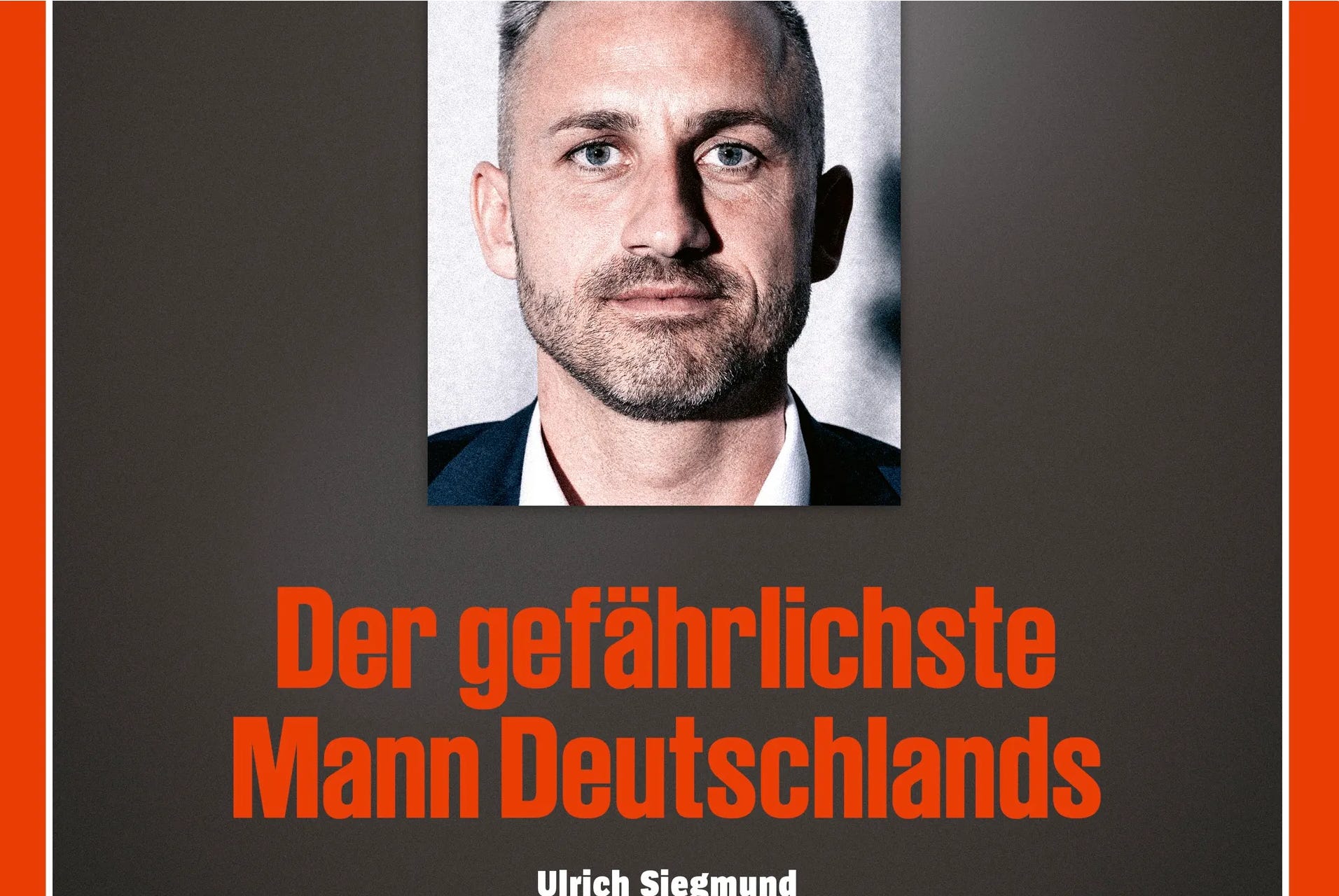
“The AfD are hip and cool, countercultural, borderline illegal! Definitely don’t vote for them!” Inside, the piece mainly just complained about what a charming man Siegmund is and how effective he has proven at political messaging. Rarely have I read anything at such cross-purposes to the clear goals of its authors. These are levels of stupid we haven’t really seen in the German press since Covid. Undirected neuroticism and hysteria are making everybody dumb.
When they are not doing everything in their power to construct the AfD as the answer to everything, our political and moral superiors are issuing threats. Antifa groups have threatened to storm the Landtag building in Magdeburg in the event of an AfD victory. German Chancellor Friedrich Merz warned that an AfD government in Sachsen-Anhalt will cause investor flight and inflict “substantial [economic] damage” on the state. Three prominent Sachsen-Anhalt CDU politicians, including lead candidate Sven Schulze, have threatened that AfD educational reforms would endanger the recognition of school-leaving qualifications in the rest of Germany. Danyal Bayaz, Green Finance Minister of Baden-Württemberg, suggested that Sachsen-Anhalt under AfD rule might find its financing via the Länderfinanzausgleich (the so-called “Federal Financial Equalization System”) restricted. Perhaps most hilariously, the pro-migration umbrella organisation LAMSA threatened that as many as 80% of all migrants living in Sachsen-Anhalt would consider leaving the state should the AfD come to power there. And last but not least, the economist Reint Gropp has warned that an AfD government could cause the economy of Sachsen-Anhalt to enter an indefinite recession.
So the message, in summary, has been: Don’t you dare vote for the AfD because voting for the AfD might actually work. If you vote for them the left will get really pissed off and do some rioting, also a lot of bad economic things might happen for vague reasons we just pulled out of our asses, also it might ruin your children’s career prospects and also all the migrants might just leave Sachsen-Anhalt out of pique.
Nobody will be surprised to discover that this rhetoric has not worked and that AfD polling numbers remain strong, but I at least am a little shocked that we haven’t seen any more serious anti-opposition efforts of the kind we witnessed in the run-up to the European elections in 2024. Nor have we seen any hardball efforts to fortify the election, for example by lowering the 5% hurdle for Landtag representation. The reaction to this looming political defeat feels simultaneously resigned, depressed and directionless.
The chance that the AfD will win an outright majority and enter government above the district level for the first time in their twelve-year history stands in my estimation between 30% and 50%.
Everything depends on how many parties make it into the Landtag. As you know, smaller parties that fail to win 5% or more of the vote are excluded from representation entirely. The more parties that fail to cross the 5% hurdle, the smaller the percentage required to win an outright majority of Landtag seats. Right now it is completely certain only that the AfD, the CDU and Die Linke (the Left Party) will get more than 5%:
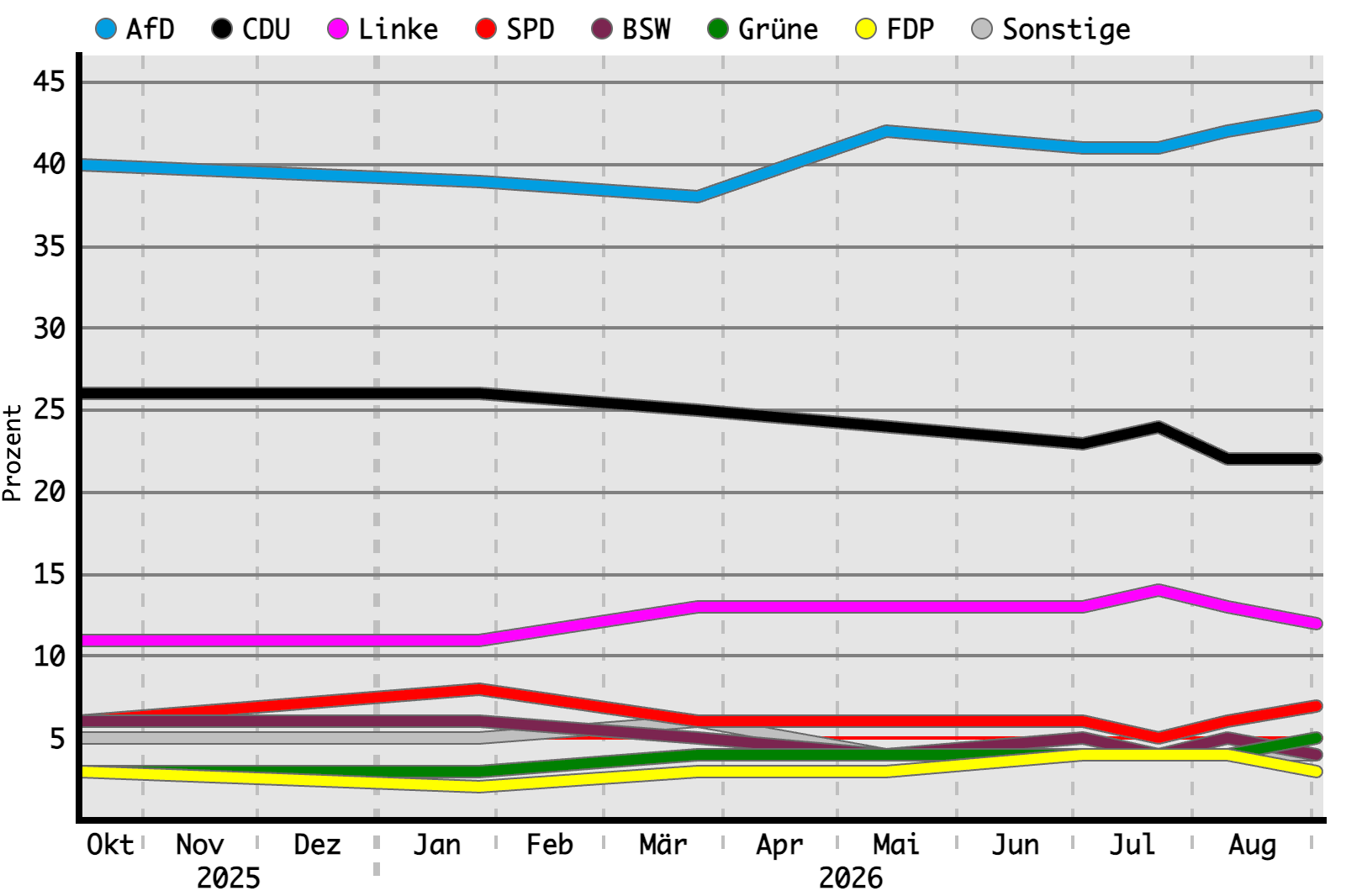
It seems more than possible that the SPD will make it into the Landtag as well – they’ve recovered slightly from their mid-summer doldrums and are back around 7%. The Greens are at 5%, and have at best a 50% chance of making it. Everyone now thinks it’s increasingly unlikely that the Bündnis Sahra Wagenknecht (BSW) will get much more than 4%, as momentum has turned against them; and nobody believes the liberal FDP has a shot here.
The possibilities that await us tomorrow are therefore these:
1) A three-party Landtag, with SPD and Greens both failing to get more than 5% of the vote. In this case, there is no doubt that the AfD will have a clear majority of Landtag seats and that Ulrich Siegmund will be the next Minister President Sachsen-Anhalt.
2) A four-party Landtag, with SPD scraping in but the Greens falling short. In this case, the AfD will need to outperform the polls just slightly and capture 43% or more of the vote. This is conceivable but it will be close.
3) A five-party Landtag, with SPD and Greens both achieving representation. In this case, the AfD will almost certainly not win the vote share necessary for a parliamentary majority.
I think it’s possible (though I’m not totally certain) that our surveys are overestimating support for the small parties in Sachsen-Anhalt across the board. Most of the polls, remember, consist of percentages that are weighted according to the prior assumptions of the pollsters. Earlier this year, most polls seriously overestimated small party performance in Baden-Württemberg and Rheinland-Pfalz, because these pollster assumptions were wrong. If that trend repeats in Sachsen-Anhalt, then it’s probably going to be SPD struggling with the 5% hurdle and the Greens well below it. Another reason to think this might happen, is the fact that turnout tomorrow is going to be enormous, if not record-setting. High turnout generally makes it harder for smaller parties to drag themselves across that crucial 5% mark, because it is the big parties and not the small ones that send most of the people to the polls in the first place.
Lest you think this is all motivated reasoning, you should know that the best outcome, from the establishment and especially the Union perspective, is an outright AfD majority according to either scenario 1) or 2). Should the AfD narrowly miss this goal, the Union would be compelled to seek support from the Left Party to form a government – an eventuality so distasteful to Union voters in the East that it could well result in an AfD government anyway, as many Union back-benchers would be tempted to defect and vote Ulrich Siegmund into the Minister Presidency.1 The ramifications of a political fuckup like this could well take down the Federal Government. Sven Schulze and the wider CDU fear the implications of being forced to cooperate with Die Linke so much that they’re contemplating a strange and unprecedented move to block the formation of a new government in Sachsen-Anhalt entirely.2
Siegmund has said he will not seek the premiership if his party does not have a majority of Landtag seats, which would seem to foreclose this possibility, but he has to say that right now – he wants people to vote for his AfD and not for other parties hoping they can get AfD anyway. What happens after tomorrow in the event of a near-miss for AfD is according to me still highly uncertain.
If all non-AfD parties have a majority among themselves, they can theoretically work together to keep the election of a new premier off the agenda. The new parliament would thus refuse to vote for and install a Minister President and Sachsen-Anhalt would remain in the charge of a crippled and frozen caretaker government under Sven Schulze, potentially indefinitely. We would achieve levels of Our Democracy never before thought possible.
Not long after I started following eugyppius' Substack, I predicted that AfD would someday become the majority party of the entire Federal Republic, not just one state. Their policies are not fascist, right-wing, or even very conservative, they are practical, sensible, and non-ideological, while the rest of the German political establishment has become both authoritarian and insane.
I live in the US, and actually have a calendar reminder set to check the news about the election, especially eugyppius.