

In May I was foolish enough to post a partial review of Adolf Hitler’s Mein Kampf, and suggested I’d follow up with a second part if there was any interest. Alas for me, some of you were interested. Alas for you, I am weak and distractible, and so I’ve dragged my feet. For all of its purported naughtiness Mein Kampf is a serious snooze of a book, and I had enormous trouble summoning the motivation to make my way through the second volume, which if you can believe it manages to be even more tiresome and boring than the first one.
I finally solved this problem by putting myself on a daily dose of Mein Kampf. Every morning I would wake up and ingest a few grams of Hitler alongside my multivitamin. In this way I’ve finally completed the entire monstrosity, and I’m happy to present you with the rest of everything I have to say about it.
First, though, I want to address those who found themselves offended by my first post on this book. All aspects of Adolf Hitler’s persona, it turns out, are attended by a diffuse crowd of mostly American internet people who act as the man’s reputational bodyguards and profess to feel great personal injury every time anybody speaks even vaguely ill of this historical figure who died 80 years ago and whose relevance for present-day politics has never been more obscure.
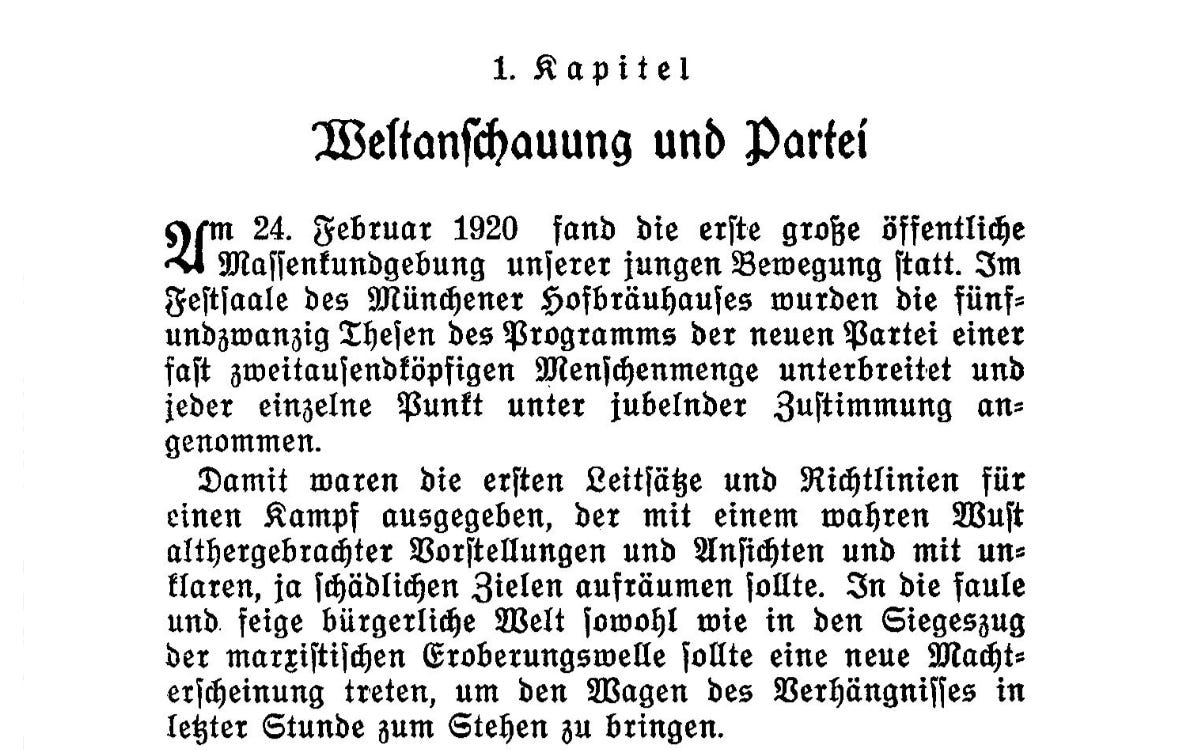
The evangelists among these guys believe I’d just love Mein Kampf if only I weren’t reading it in one of these clunky outdated English translations. They’ve assured me that in fact Germany’s most famous Führer is an excellent stylist and that if I’d just have a look at the wonderful new translation by Thomas Dalton I would absolutely love Mein Kampf. In fact – and I don’t know how these guys missed this – I’m reading Hitler in German, to be precise in the 2016 two-volume IfZ critical edition, where his stylistic faults appear in abundance. Studying this edition has convinced me that Hitler himself knew something was wrong with his style, because he frequently tinkered with the prose across successive print runs, adding hundreds upon hundreds of niggling corrections which the IfZ editors carefully track in a marginal apparatus. None of this helped and the book remains an amateurish trainwreck by any standard. All of that said, I can see how a loose and charitable translator might be tempted to improve Hitler’s readability. I’ve done some of my own Hitler translating for this post and I can say that the urge to iron the wrinkles out of the man’s cramped style becomes quite powerful.
Others believe either a) that I’m trying to score Good Boy Points by saying that I do not like Mein Kampf, or b) that I am legally prevented from speaking positively of Hitler or anything he wrote because I live and write in the repressive open-air nursing home known as the Bundesrepublik Deutschland. I’ll take these in reverse order.
In fact it would not be illegal for me, even in Germany, to write positively of Hitler or his works, as long as I didn’t extend my praise to a general peace-disturbing glorification of the violence and arbitrariness of National Socialist rule. The Bundesrepublican censorship regime with respect to forbidden midcentury topics operates at a painfully superficial and symbolic level, and does not pose great obstacles to my expressing opinions about this era. If I did think my honest takes on some subject would get me in trouble, I hope you know I’d just avoid that subject entirely rather than serve you a bunch of disingenuous politically correct nonsense.
As for a), I can only repeat what I said last time, which is that my project in reviewing tabu books is to evaluate them on their own terms and withhold my own moral commentary. Mein Kampf suffers from extremely obvious stylistic, structural and even grammatical defects, and its shortcomings are interesting for a few reasons. First of all, they’re evidence for who the National Socialists were and by extension what it took to come out on top in the chaotic politics of the Weimar Republic, which favoured street smarts and ruthlessness much more than intellectual horsepower. Perhaps more intriguingly, they also tell us about the strange strategy postwar liberalism has pursued against the spectre of its defeated Nazi enemies, because laying a tabu upon Mein Kampf was in fact wholly unnecessary and, from a naive perspective, even counterproductive. Indeed, few exercises seem more likely to cause profound disillusion with National Socialism than reading this one singular book. Exactly why the postwar BRD fought so hard to prevent ordinary Germans from discovering that Hitler was a terrible writer and a bad thinker is an interesting question, and something I’ll have more to say about at the end of this piece.
My first post addressed general matters together with the contents of the first volume (“A Reckoning”), which Hitler wrote on a typewriter while serving a sentence for high treason in Landsberg Prison. Here I’ll take a closer look at Hitler’s prose style via a few important excerpts in my own translation, before considering the second volume on “The National Socialist Movement,” which Hitler dictated after his release and which appeared in December 1926.
If you want to read further, maybe you’ll consider subscribing. Without your support nothing I do here will be possible.