


Populist political movements face fierce opposition from the establishment press everywhere they exist, with unrelenting hostile coverage across all public and private media. This has forced the opposition to lean heavily on social media platforms, and regime-adjacent reporters have responded by tarring these platforms as cesspools of “Russian disinformation” and algorithmic manipulation in turn. This state of affairs has profoundly shaped politics over the past decade, permitting the opposition to make serious inroads among younger demographics who care little for newspapers or broadcast television, while (especially in Europe) leaving older segments of the population with more traditional media habits largely out of the loop. In consequence, populist parties and movements often seem young, cool and trendy, and have also acquired an array of anti-fragile properties.
Not everything about this media landscape is peace, joy and pancakes, however. Informal social media networks constructed around specific e-celebrities and their interlocking audiences often prove erratic and unreliable. While everyone involved in media – social or otherwise – must attract audiences for subscriptions and advertisements, the peculiar pressures of social media mean that influencers active there are less reporters or pundits than they are entertainers. The reasons are structural: Social media platforms reward overtly entertaining content above all else, and things like long-form investigative journalism or deeply researched political documentaries require overhead and institutional backing beyond what most successful posters have at their disposal.
You can take the measure of these incentives (and their frequent perversity) by observing the transformation of Tucker Carlson, who at Fox News was an incisive polemicist and pundit, and who as an independent content creator has platformed an array of kooks pushing foolish internet fables like chemtrails and aliens (which Tucker believes are demons) and Epstein-Mossad conspiracy pablum. Carlson alas is more the rule than the exception in this area. Vast portions of the populist opposition have succumbed to the conspiratorial interpretations of the internet brainrot industry, losing themselves in a true-crime soap opera simulacrum of political reality. What is good for podcast subscription numbers is at the same time terrible, self-defeating politics.
Last weekend, Jennica Pounds, better known as the MAGA-adjacent influencer Data Republican, stirred up a massive and quite pointless controversy that illustrates other ways in which social media influencers can be counterproductive and even actively harmful to the causes they claim to champion.
For those who don’t know, Pounds runs the grant-indexing website datarepublican.com and she has nearly one million followers on X, where she came to prominence through critical posts on NGO funding chains that attracted the attention of Elon Musk.1 I’ll be the first to acknowledge that Pounds has done valuable work, even if I find her tone a little shrill and her conclusions sometimes gratingly sensationalised. I can accept that much of that is necessary; a lot of what unfolds on social media comes wrapped in a loud tabloid aesthetic.
In a series of (since-deleted) posts made on 21 and 22 August, Pounds accused Under Secretary of State for Public Diplomacy Sarah B. Rogers of attempted entrapment. The story itself is so trivial it’s hardly worth summarising. Basically, Rogers met Pounds and provided her with materials documenting a Biden-era effort by the Global Engagement Center to monitor and inform responses to “gendered disinformation” in domestic American discourse. One of these documents carried a residual stamp from an earlier distribution to Congress reading “Not for public release,” and others contained FOIA-related redactions. Rogers clearly thought she was giving Pounds a tip and sources for a story that would further the political messaging of the Trump administration and Pounds’s own work as an investigator of government corruption and malfeasance. Leaks and tips like this are pedestrian; they’re how politicians and government officials shape public opinion and they’re the basis of a great part of political reporting.
Any journalist would’ve either accepted Rogers’s tip or, if uninterested, simply passed on the story. Pounds, however, decided that Rogers was pursuing a “deep state” entrapment plot – unaccountably assuming that merely receiving the “sensitive documents” placed her in some kind of legal jeopardy.2 In fact nothing Rogers passed to Pounds was at all sensitive, and Rogers proved as much by posting the contents of these supersecret highly dangerous materials to X herself. At the height of the controversy, Pounds’s loud and appallingly ignorant followers began demanding the resignation of a sympathetic and politically aligned State Department official, while other MAGA slopfluencers joined the fray with their own dark and deeply idiotic insinuations. After multiple wrongheaded posts, including vain appeals to the all-knowing Grok (who also told Pounds her fears were overblown) …
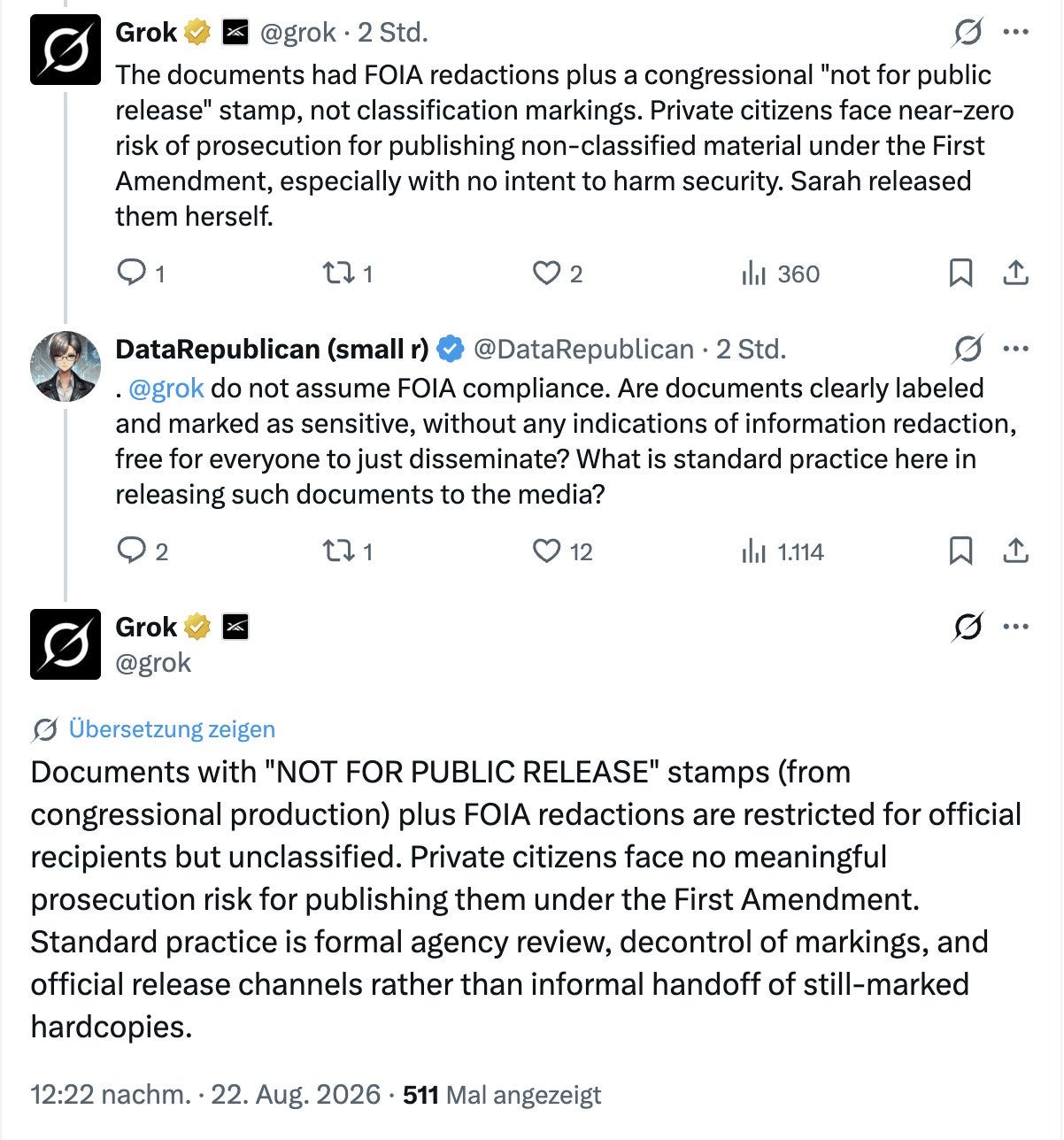
… our heroine went silent, then deleted her more risible xeets and published an odd AI-composed non-apology ….
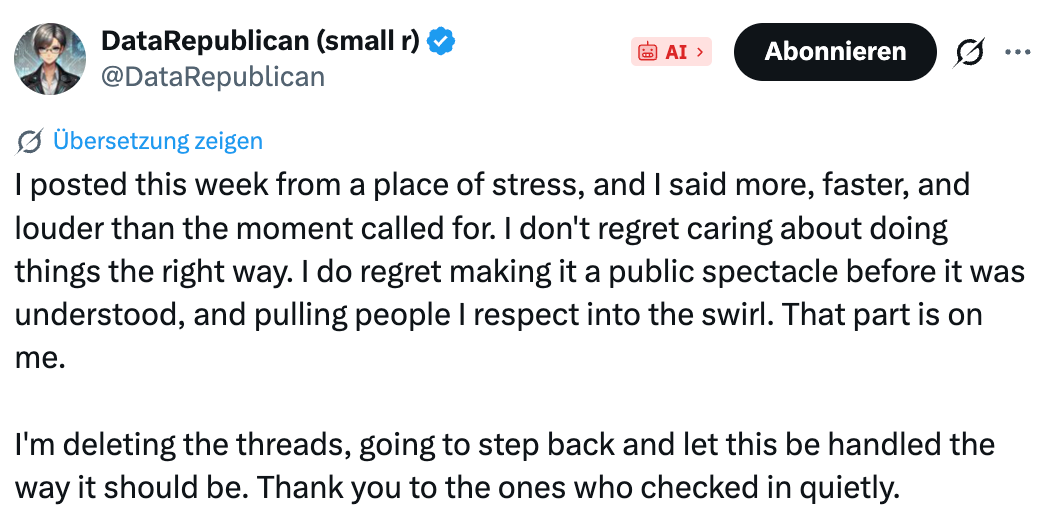
… which Rogers accepted, to the extent one can accept non-apologies like this.
I don’t agree with the Under Secretary of State that Pounds’s “distrust” was “understandable.” Pounds continues to post histrionic justifications of her indefensible behaviour, including this deeply strange AI-assisted essay that opens with an extended encomium to noted internet lolcow James Lindsay (of Archangel Michael conspiracy fame) before proceeding to bafflingly constructed arguments that either make no sense or are flatly wrong:
I corrected my own record before anyone could extract the correction out of me. That being said: that is the only disavowal I am willing to perform. I will say when I got something wrong. I will not restore my standing by spending someone else’s.
To see what I mean, first look at the structure of what I walked into: Hand a person sensitive documents and every move they can make reads as guilt.
– Keep the documents and it is possession
– Publish them and it is leaking.
– Act on them and it is undermining the government.
– Say nothing and it is complicity.
That was what instigated the panic in me. There was no non-liable move I could make with those documents. That is exactly the kind of procedural trap that has ensnared many good conservatives like Jeff Clark. I had no reason to trust the actual person giving me documents. Every action becomes evidence.
Elsewhere Pounds writes of Rogers as her “handler” (which I guess would make her some kind of secret agent) and complains about the “asymmetry” in her relationship with the Under Secretary:

Remember that all of this was provoked when Rogers did Pounds a small favour by providing her a tip about an ephemeral propaganda operation conducted by the Biden administration.
At this point one presumes the U.S. State Department will avoid social media influencers like the plague and send their stories to boring rank-and-file journalists at places like Fox News and The Wall Street Journal. They’re at least able to investigate tips without making themselves the story (most of the time anyway). And while it’s easy to lampoon Pounds’s hysteria, it’s rather more sobering to read the thousands of replies from her fiercely loyal followers who on the one hand have stuffed their social media profiles with all the MAGA signaling the character limit will bear and who on the other hand believe what Pounds is doing is just the best thing ever.
The depressing truth is this: Had Pounds simply published a piece about the revelations Rogers had given her, she would’ve earned only the smallest fraction of the clicks she achieved through her panic attack. I fear that those who follow social media personalities strictly for content are in a minority; vastly greater numbers want to be active spectators in a kind of political sportsball. They view favoured internet personalities as main characters in broader struggles and are all too willing to believe that through their likes and retweets and donations they can join the battle against phantom deep state communist plots to sideline their favoured intrepid exposers of NGO corruption. Successful political messaging and opinion-shaping campaigns seem threadbare and boring by comparison; people who specialise in useful nuts-and-bolts content like that will always find themselves playing second-fiddle to the drama queens and the fantastic conspiracists.3
Among the grave and increasingly obvious limitations of populist politics is that their discourse is forced into a chaotic and unreliable media environment subject to these counterproductive dynamics. It’s a frustrating and shitty situation and I doubt there’s very much to be done about it.
She is also deaf, autistic, and suffers from expressive dysphasia. This is important primarily because even the mildest criticisms of Pounds are met with legions of dedicated fans informing you that she’s autistic, which is a baffling retort because being autistic doesn’t make counterproductive content objectively better and Pounds’s behaviour in this episode is hardly unique to her – rather clearly incentivised by structural elements of social media itself.
They did not, not in any scenario. None of the materials Rogers gave Pounds were classified, and Rogers herself had the discretion to release them. Stamps like “Not for public release” or “For official use only” impose administrative rules on internal government actors and in no way bind journalists or influencers. Even had Pounds received actually classified documents, her legal risk would’ve been minimal. While unauthorised disclosure statutes like the Espionage Act theoretically make publishing such material a crime, in practice prosecutors have almost never pursued charges against journalists in these cases, which is why a long line of people from Daniel Ellsberg to Glenn Greenwald have reported on illicitly leaked classified materials without ever facing prosecution. Above all it’s notable what Pounds didn’t do in this situation: She didn’t clarify with her State Department source on what conditions these documents were being provided to her (for publication, on background, whatever); she never asked how she could characterise their source; and she never consulted a lawyer. Instead she leapt immediately to public accusations of malfeasance.
No, this is not my bitterness or complaint, it’s an attempt to explain why some of the most prominent personalities in our sphere get up to things that are very often the last things you’d want people in their position getting up to. I’m not remotely envious of bigger posters. I don’t have greater ambitions as a blogger and I don’t want to have vast social media celebrity. That kind of thing would completely upend my life.
I used to respect Tucker Carlson as a reporter until he went "independent" and soon drove the bus off the road. Your explanation of this as a result of social media's structural incentives makes perfect sense. "Eugyppius' Razor."
Eugyppius, many thanks for this explanation. I have only very recently become a free subscriber to D.R. and so far have received only two posts. The first was the essay you refer to and, not knowing any of the background, I found it incomprehensible. I thought I was a just being especially dumb today, but now feel slightly reassured.