


People in our sphere like to talk about this thing called the Overton Window.
Anytime somebody proposes a political initiative or a protest movement or a petition or a publicity campaign that is either manifestly unworkable, counterproductive or ill-advised, we hear that we should lend our support nevertheless, because whatever this misbegotten thing might otherwise be, it is absolutely sure to “move the Overton Window.”
This fuzzy concept has been invoked so many times in so many contexts that it has become a parody of itself. I am tired of hearing about the Overton Window. I think it is a reductive and also an obfuscatory theory about mass democratic discourse that is promulgated only because it furthers the interests of specific people with large audiences and activist agendas. You don’t hear about the Overton Window because it is a useful model of policy or opinion formation. You hear about the Overton Window because it justifies the importance of countercultural discourse activists (I propose to call them “Overtonians”) and the kinds of things – protesting, tweeting, petitioning, podcasting, interviewing, publishing, and yes, even substacking – they get up to.1
Superficially, the Overton Window sounds unobjectionable enough, if not painfully self-evident. The term denotes (in the neutral formulation of Wikipedia) “the range of subjects and arguments politically acceptable to the mainstream population at a given time.” Also “key to the concept is that the window changes over time; it can shift, shrink or expand.” Thus the Overton Window comes inseparably packaged with the possibility of moving said window, primarily because Overtonians only talk about the Overton Window to the extent they claim to be dragging it about, like a suitcase. Less obtrusive but more important are the dubious assumptions and vague terms that the Overton Window brings in its wake. Chief among the former is the slyly unstated idea that the Overton Window is a singular, bounded entity. As for the latter, the curious mind will find itself wondering what “politically acceptable” means in practice and what this entity called a “mainstream population” is and where it is to be found.
Some concepts have so little substance they can hardly survive a review of their own history, and so it is with the Overton Window. The name comes from Joseph P. Overton, who worked at the Mackinac Center for Public Policy, a small free-market think tank in Michigan. In the 1990s, Overton found himself trying to explain why rich people interested in changing policy should give money to an organisation like the Mackinac Center that writes a lot of white papers while doing nothing overtly political. His pitch held that politicians are followers who at any given moment can select only from a range of publicly acceptable policies, and that it is the task of think-tankers like Overton to move this range of acceptability around by writing things, or something. Overton died in a plane crash in 2003 before he could publicise his framework, and his colleague Joseph Lehman was left to popularise the idea. Lehman gave the concept its name and tethered it to an equally dubious ladder of discursive stages, according to which any given political idea exists somewhere on a scale from unthinkable to radical to acceptable to sensible to popular to policy, depending on how it is aligned with our eponymous window.
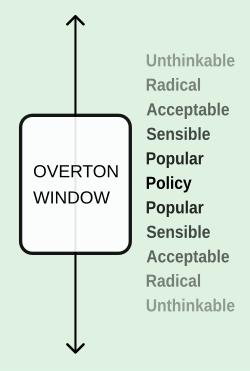
From its very inception, then, the Overtonians fielded their concept of the Overton Window not because it provided a productive way to conceive of opinion formation or consensus, but simply as an argument for why donors should give money to the Overtonians. The term itself broke into the mainstream after Glenn Beck published a ghostwritten thriller bearing that name in 2010, after which internet discussion surrounding Donald Trump’s first presidential campaign in 2015 promoted the Overton Window vastly beyond its competence into a General Folk Theory of All Discourse. For a decade it has been nothing but Overton Windows and the moving of them, which is a shame, because there are much more productive ways to think about how opinions and policies are formed in mass democratic systems.
To begin with, there is not one singular undifferentiated “mainstream” that acts on policy. There is a cultural elite responsible for opinion formation within the realms of those who hold political power, and beneath them there are the rabble, subdivided across various discursive sectors. Ideas may enjoy more or less popularity among the elites or the rabble, but they also have a another somewhat unrelated and vastly more important property we might call articulability. Any given position may enjoy a great deal of popularity while being essentially unspeakable or inarticulable in ordinary discourse; conversely, elites can and do enact highly articulable or speakable policies even when these are fundamentally unpopular. Here, ideological and moral systems impose constraints on the positions people can espouse and the way they can espouse them, while denying the advocates of many popular positions the intellectual authority and sometimes even the words necessary to press their views.
From Covid containment to climatism to mass migration, we see that elites again and again enact obviously wrongheaded policies well in advance of public opinion formation, and sometimes even before elite opinion itself has solidified. These are invariably policies which are highly articulable, which is to say they lend themselves to easy expression within the prevailing system of moral and political values. Saving lives, protecting the environment and welcoming refugees from war-torn lands sound like good ideas and they are boosted by a whole world of moral beliefs inherited from the liberal tradition. These high-minded measures bring with them a manic media-fueled euphoria before the eminently foreseeable consequences become clear. From that point on, these bad decisions are quietly opposed by growing numbers of people, first among the rabble but later also in specific elite sectors. Crucially, this opposition happens on inarticulable grounds, because in our highly egalitarian societies there is no easy way to say that saving lives is not always a reasonable end, that the only thing worse than emitting too much CO2 is emitting too little CO2 and that our states do not exist to succour the world’s unfortunates.
I’ve expressed articulability in binary terms, but it’s better to think of this property as finely variable and audience-specific. All ideas, from Maoism to anarcho-capitalism, will of course enjoy articulability among specific subcultures, but the more this articulability depends upon foreign moral systems or arcane terminology or unfamiliar prior beliefs, the less articulability these ideas will enjoy beyond their originating fandom. Ideas that are broadly articulable across many audiences and within the elite specifically can travel quite far regardless of their popularity. The Davos set in particular proved to be prolific collectors of every last highly articulable yet deeply unpopular idea they could find, from degrowth to insect protein to fifteen-minute cities.
It is tempting to blame everything on flabby Western liberalism, but simple social acceptability is probably the most powerful factor influencing how far arguments and ideas can travel. The most highly articulable ideas all seem at first glance friendly, frugal, inclusive, charitable, selfless, kind, nurturing, gentle and open. They appear to be about sharing rather than taking, equalising rather than singling out. Everything that can be argued on soft terms like these enjoys outsized social acceptability and thus an enormous advantage. Conversely, ideas which seem to be exclusive, selfish, unkind, complex or rooted in hierarchical assumptions confer social stigma and take a serious articulability hit, however prudent and advisable they may be in fact. In conditions of mass democracy, the soft and the infantilising will be preferred over the hard and the necessary again and again.
States and the politicians who purport to manage them do not just receive and implement the substance of public opinion. They act instead through highly complex, heavily bureaucratised institutions, which control not only what politicians can do but also which problems they can even perceive and fundamentally how they conceive of their scope for action. Clearly, opinions which make their way into elite circles can influence institutional and therefore state behaviour, but via their institutionally mediated actions states shape political discourse in turn.
The institutional filter is therefore another very huge piece of the puzzle here. State institutions have enormous inertia; they fix and maintain orthodoxies for years and generations, even as consensus shifts beneath them. They monopolise most areas of state policy and they work primarily out of view, because most of the things states do are not the subject of any political discussion. In countless areas, these institutions implement policies according to dominant paradigms (what two theorists have called “policy images”2) which explain which problems are to be solved and how.
These paradigms and their associated policy monopolies benefit specific people, but as in all things there are inevitably losers whom they harm, and when policy goes bad or cultural consensus shifts the pool of losers and discontents grows. Crucially, this doesn’t matter initially and sometimes it never matters at all; institutions are well-insulated against public opinion, they don’t have human moral understandings and they’re happy to impoverish, ruin and kill people. Opponents can succeed only via generational turnover, or if they can get rival institutions to take an interest in their cause. Oppositional views no matter how popular can only exercise influence once they have gained this crucial institutional purchase. From there they have some hope of shattering the prior paradigm; new policy images, with differently aligned institutional monopolies, then emerge to fill the new space. States do not calibrate their actions according to slow adjustments of any windows. They rather experience long periods of institutional and political stasis, punctuated by moments of sudden realignemnt.
In summary: The Overton Window is a simplistic fable about political discourse and nobody serious should mention it. There is no single, coherent window of socially acceptable ideas that can be moved back and forth, compressed or expanded. Rather, different pools of ideas maintain currency across different parts of the political spectrum, often wholly discontiguous from each other, often with considerable overlap. Public discourse is better modeled as a two-tier system, with cultural elites acting as gatekeepers and ideas benefiting from prior inherent and contingent articulability. The popularity or currency of any given proposal does not matter very much; many policies are enacted against popular opinion or well in advance of its formation. Unless Overtonian advocates can find an institutional venue for their opposition, their advocacy will go nowhere no matter how many people they win over to their side.
To be clear, not everyone engaged in protesting, tweeting, petitioning, podcasting, interviewing, publishing and substacking is by that very fact an Overtonian. Nor is everyone who fires a rifle a soldier. Overtonians generally have activist political ends which they claim to pursue by doing all of these things.
Frank Baumgartner and Bryan Jones, Agendas and Instability in American Politics (1993).
I am glad it was you who tackled the Overton Window. Your demolition is a thing of beauty and a joy to read. Thank you.
If anyone is interested in setting up a research institute where we can troll for grants to study why people might want to give us grants, let me know!