

Consider three recent anecdotes from German politics:
1) In a rambling editorial recently printed in his organisation’s own newspaper, the deputy federal chairman of the Union of Police argues that German police cannot support Alternative für Deutschland: “Anyone who takes his oath of office seriously has no choice: the AfD is a no-go! By virtue of the oath they have sworn, police officers cannot vote for, support or join a party that is hostile to the constitution.” Should the AfD enter government in Sachsen-Anhalt following the September elections, he argues that state riot police should work together with the Federal Police on the strength of article Article 91 of the German Basic Law to intervene against the government of this East German state, all in order “to restore constitutional order.”
2) A year ago, the Social Democrats (SPD) nominated a terrible pinched woman named Frauke Brosius-Gersdorf for a seat on the Federal Constitutional Court in Karlsruhe. In part because Brosius-Gersdorf is a horrible person and in part because Chancellor Friedrich Merz is an incompetent fool, the nomination provoked a grassroots revolt within the centre-right Union parties. After multiple Union MPs refused to vote Brosius-Gersdorf onto the court, citing her unacceptably liberal views on abortion, not only the SPD but also the Greens and the press and elements of the CDU embarked upon a sustained temper tantrum about the interference of alternative media and populist elements in court nominations. The CDU Minister President of Schleswig-Holstein Daniel Günther in January complained that “NIUS and similar websites” – which he characterised as “opponents of our democracy” – were responsible for sinking Brosius-Gersdorf’s nomination. When asked whether Günther was saying that “we need to regulate [alternative media], we need to censor it if necessary, and in extreme cases even ban it,” Günther agreed: “Yes.”
3) After the February 2025 elections, Alternative für Deutschland became the second-largest party in the Bundestag, with 151 MPs; the Social Democrats booked historic losses and landed in third position, with just 120 MPs. The AfD assumed their second-place finish would entitle them to the second-largest party caucus room. This chamber, officially designated “3S 001”, has been occupied by the Social Democrats since 1999; they christened it the “Otto-Wels-Saal” after one of their political heroes. Despite their shrunken numbers, however, the SPD refused to relinquish their room, and ultimately the establishment parties used their combined votes on the Bundestag’s cross-party steering body (the “Council of Elders,” or Ältestenrat), to compel the AfD to accept a substantially smaller chamber. Despite their reduced numbers, the SPD continues to caucus in their overlarge “Otto-Wels-Saal,” while the AfD have been granted a supplementary room to ease crowding. Their legal challenges have thus far failed.
I could provide many more examples in this vein, but three are enough for my purposes – these being to describe how Germany is actually governed and how the establishment parties of Germany consider their relationship to the state.
In civics class, parties appear as little more than informal election-winning cooperatives. Now and again “the sovereign” – that is to say, “the people” – may grant one or various parties a limited right to govern, but the state is held to be in some sense public property. Politicians and their parties are at best its temporary custodians.1
Our Democracy Enjoyers particularly deplore state systems in which parties have captured the state – a special political form we might call the “party state.” Germany became a party state after 1933, when the NSDAP seized the entire state apparatus and outlawed all competitors. Contemporary states owned and operated by single parties include China, Cuba and North Korea. Our Democracy Enjoyers hate all single-party states because they are not democratic.
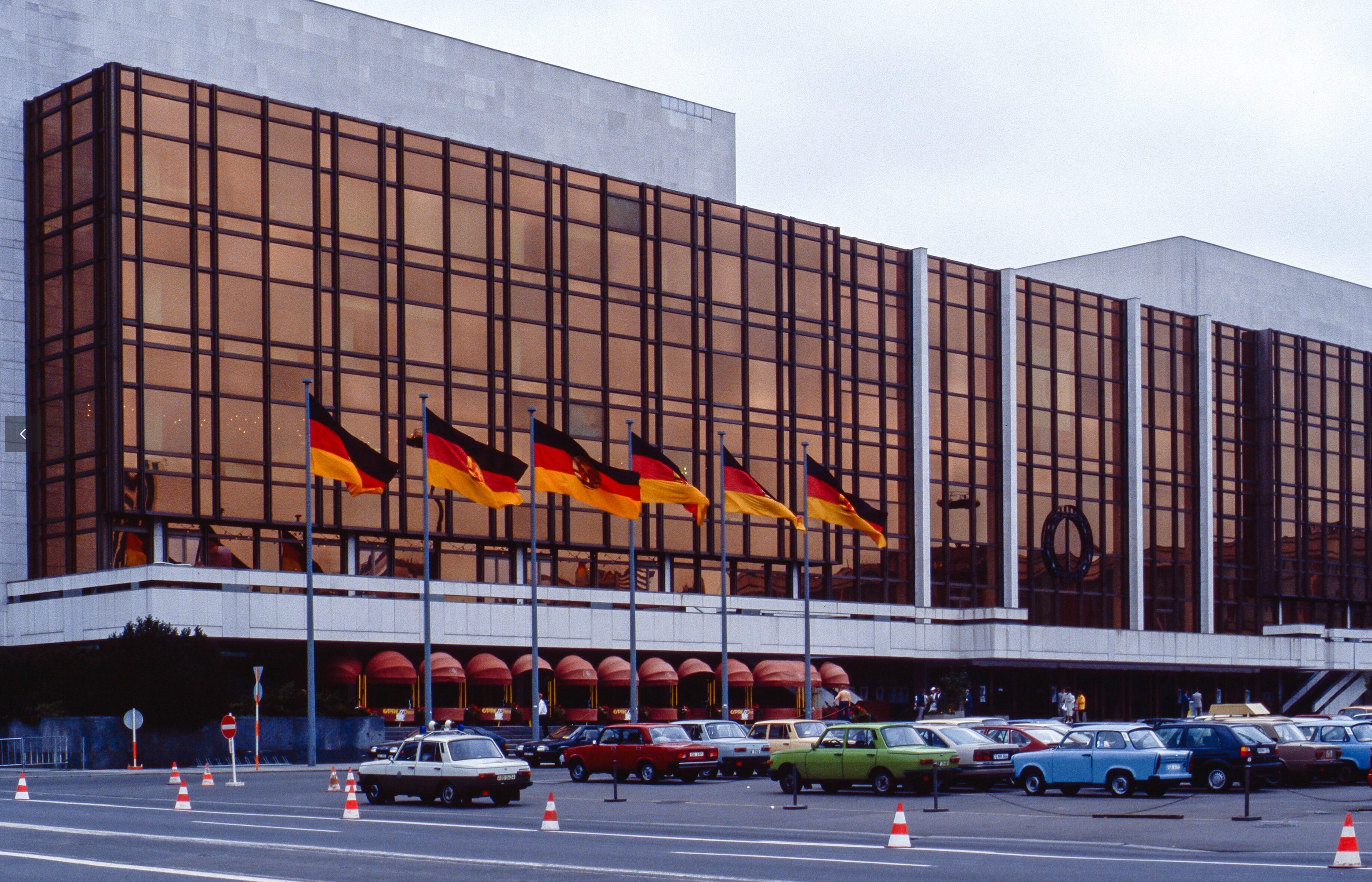
Party states need not however be single-party states. While the Socialist Unity Party (SED) effectively owned the DDR, they tolerated an array of subservient bloc parties from the very beginning. None of these parties ever had any chance of governing; they functioned only as extensions or alternative faces of the SED itself. These parties included gutted, early opposition parties like the CDU (Ost) and the Liberal Democratic Party (LDPD), but also SED concoctions like the Democratic Farmers’ Party (DBD) and the cynically post-Nazi National Democratic Party (NDPD). The SED cultivated these parties both as a democratic figleaf and also to integrate “non-proletarian” (particularly Christian) elements within the communist system. The precedent of the DDR shows that the party state can assume various innovative forms and that multiple parties may be useful for political, propaganda or other purposes.
My thesis of the Federal Republic is that it is also a party state. The only difference between the DDR and the BRD is that, in the BRD, several different parties share ownership of the state among themselves.
The three anecdotes at the head of this piece reveal this party ownership in incidental but telling ways. They show, for example, how a substantial portion of the police consider their oath of office to preclude loyalty to a democratically elected opposition party. Should the voters go rogue and install any such party at the state level, a prominent police union functionary openly hopes for insurrection and federal intervention. Periodically voiced ambitions and campaigns to cleanse the civil service of AfD elements come from a similar place. The ownership parties cannot countenance opposition creep into the bureaucracy, because they correctly regard the bureaucracy as their property.
The hysteria surrounding a thwarted SPD nomination to the Federal Constitutional Court reveals that the parties that own the BRD extend their proprietary interests not only to the executive and legislative branches, but also to the allegedly independent judiciary. The ruling parties have divided the prerogative to nominate judicial candidates informally among themselves. This prerogative is so jealously guarded that a leading Union politician cited a single thwarted SPD nomination to make the case for mass censorship and regulation of “alternative” media.
And while it is a minor incident that hardly matters, the dispute over the Otto-Wels-Saal shows that the proprietary feelings of the state parties extend to physical architecture, even specific rooms and buildings, which the parties of the party state regard not as public property but as their very own chambers – to name, possess and use as they see fit.
While progressive liberal political systems are all oligarchies, and this because of the Iron Law of Oligarchy, they are not all party states – far from it. The party state is a clunky and outmoded political system that historically arose out of accident or necessity, generally following a revolution perpetrated by a single party or political movement in a moment of particular ascendance. The Federal Republic was founded as a party state in 1949, mainly to foreclose the possibility that subversive National Socialist or communist elements might return to influence via democratic processes. This is the basic meaning of German “defensive democracy,” which denotes an array of legal or constitutional tools for the parties that own the state to fend off or criminalise competitors.
The parties do not all own the state equally. The Union parties and the Social Democrats act as more or less equal partners. Considerable electoral losses have made it more procedurally difficult for the SPD to enact its vision, but the Union continues to recognise SPD co-ownership of the state where it counts. The ordo-liberal FDP has but a small share in the ownership of the BRD, and as their decline continues they may sooner or later face outright dispossession. The Greens, meanwhile, could be welcomed as co-owners only in the political reshuffling that occurred after reunification. You could say that the SPD granted some of their share to the Green Party after 1990, and that the Greens have capitalised on their junior position by making special inroads among social elites and the press in particular.
If you want to go into politics or influence political outcomes in a party state, you have to do that by joining and then rising through the ranks of the state party, which is where all the real politics happen. In Germany, this means applying for membership in the CDU, the CSU, the SPD or the Greens. Founding new parties or political movements is permitted only insofar as these never achieve any significance. If your movement or your upstart party does matter, you’ll find yourself in serious shit. One clear symptom of a party state – particularly in parliamentary systems – is a party apparatus that never changes and remains effectively frozen in amber, generation after generation.2 While many other European countries have seen substantial upheaval their party systems, the German party landscape (setting aside the late addition of the Greens) has been fixed since the 1950s.
The AfD has been shunned as an illegitimate neo-fascist threat from the moment of its foundation, when it was merely a Euro-sceptic “professor party” full of disaffected CDU elements with no real nationalist bent. Elites are fairly open about the reasons for their hostility: They believe the AfD has manipulated democratic procedures (see my first footnote) to insinuate their way into a state that is not theirs to run. As the AfD has gained strength, the establishment parties of the party state have responded with increasingly brazen cartel tactics to keep the upstarts out of government, in the process laying bare a great deal about how Germany is actually governed. Any cooperation between the CDU and the AfD would signal an intention on the part of the Union to prise the state away from the state’s effective co-owners, which would constitute something approaching a coup. This is why any hint of rapprochement between Union politicians and the AfD causes such hysteria, and why there can be no compromise here, now or ever.
I write about this because state elections in Sachsen-Anhalt are rapidly approaching, and the AfD in that state remains on the edge of achieving an outright parliamentary majority. Even if they fall short of a majority, various procedural and other imponderables might still land them in power despite the total opposition of the establishment parties. We will soon learn, for the first time in the entire history of the Federal Republic, whether mere democratic procedures are enough to break the hold of the party state. In general, I am pessimistic that they are, even if I’m not sure what tactics the powers that be will deploy against procedural setbacks.
Now, we know this is mostly nonsense. “The people” are an abstraction and as such they cannot grant anybody anything. All political systems ultimately redound to the control of more or less stable oligarchies. “Democracy” describes little more than a set of procedures via which the these oligarchies (or their representatives) assume power and enact their will.
In structural two-party systems subject to Duverger’s Law (like the United States), I think a fixed party landscape is less diagnostic of party capture.
"Should the voters go rogue and install any such party at the state level, a prominent police union functionary openly hopes for insurrection and federal intervention."
I don't know how that is *anything* other than a precursor to civil insurrection. Everyone talks about the UK being a tinderbox, but this is bad. *Really* banana-republic-level bad. And do they not know their own history? Weimar Germany was a seething mess of competing police and paramilitary organizations tied to specific parties and all armed to the hilt. If anything it was the NAZI party that cleaned that up and introduced a level of uniformity to the uniforms.
Just how stupid are office-holders in Germany? Their voters? Every day my old impression of German intelligence and industry seeps away ever further.
'"…state riot police should work together with the Federal Police on the strength of article Article 91 of the German Basic Law to intervene against the government of this East German state…"'
'…a prominent police union functionary openly hopes for insurrection and federal intervention.'
So the Constitution mandates insurrection against the democratically elected government in order to protect the Constitution? I haven't finished drawing my chart yet, but this feels very circular.
[edited to fix a stupid copy/paste blunder]