

Within months of becoming Chancellor, Friedrich Merz promised an “Autumn of reforms,” which never materialised because the political will to fix Germany’s economic and fiscal problems does not exist within his coalition. Having failed to fix anything and driven support for the once-mighty CDU to historic lows, Merz has instead been served an Autumn of Reckoning. It is unclear whether he will survive it.
The state elections in Sachsen-Anhalt, Mecklenburg-Vorpommern and Berlin that for months have inspired fear and trembling within the German political establishment have come and gone. Each of them has realised our rulers’ worst fears in different ways.
1) In Sachsen-Anhalt, the CDU underperformed polls by more than 20%, while Alternative für Deutschland achieved the highest vote share any party has ever won in that state. The AfD are already in talks with the Bündnis Sahra Wagenknecht, and everyone expects an AfD government under Ulrich Siegmund to take power in the coming months.
2) In Berlin, the CDU managed to squander the clear polling dominance it enjoyed throughout 2025 to finish in second place with just 18.8% of the vote – nearly seven points behind Die Linke. That is what a series of extremely stupid and unnecessary local scandals alongside association with the most unpopular Chancellor in the history of the Federal Republic can do to a party.
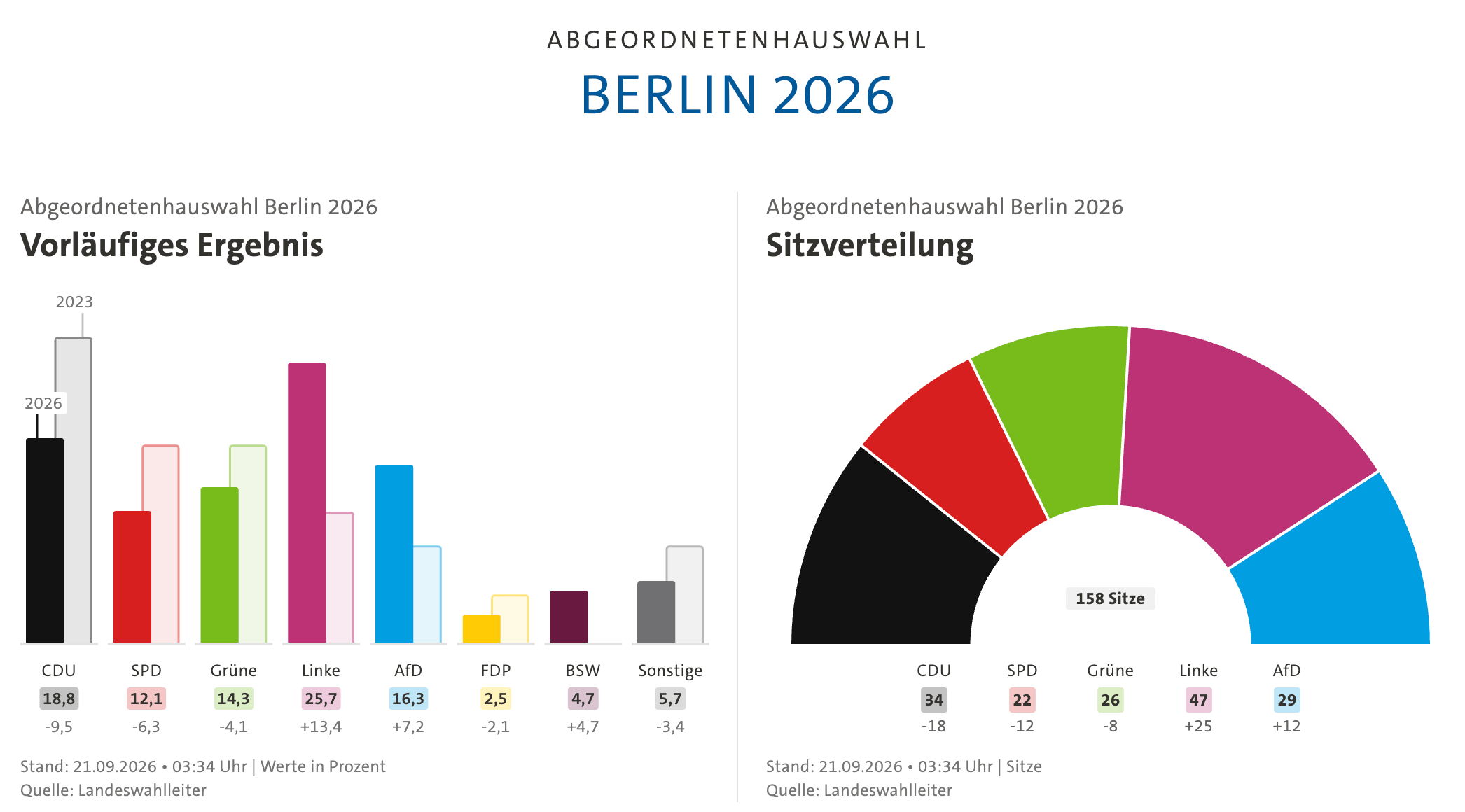
Zohran Mamdani’s advisers and campaign strategists assisted Die Linke in their left-populist Berlin campaign, which enjoyed particularly strong appeal among young voters. Assuming some late-breaking turbulence caused by the corruption and indiscipline that are typical of Die Linke do not derail things, they will form a government with the Greens and the Social Democrats.
3) In Mecklenburg-Vorpommern, the CDU managed to underperform every last poll, logging their worst electoral result in all of history. With just 4.9% of the vote, they failed for the first time ever to scrape across the 5% hurdle for representation in the Landtag – an outcome I have predicted for weeks. Whereas in Sachsen-Anhalt voters overcame the firewall by making the AfD too powerful to wall off, in Mecklenburg-Vorpommern they abolished it entirely by kicking the party that invented and maintains the firewall straight out of parliament.
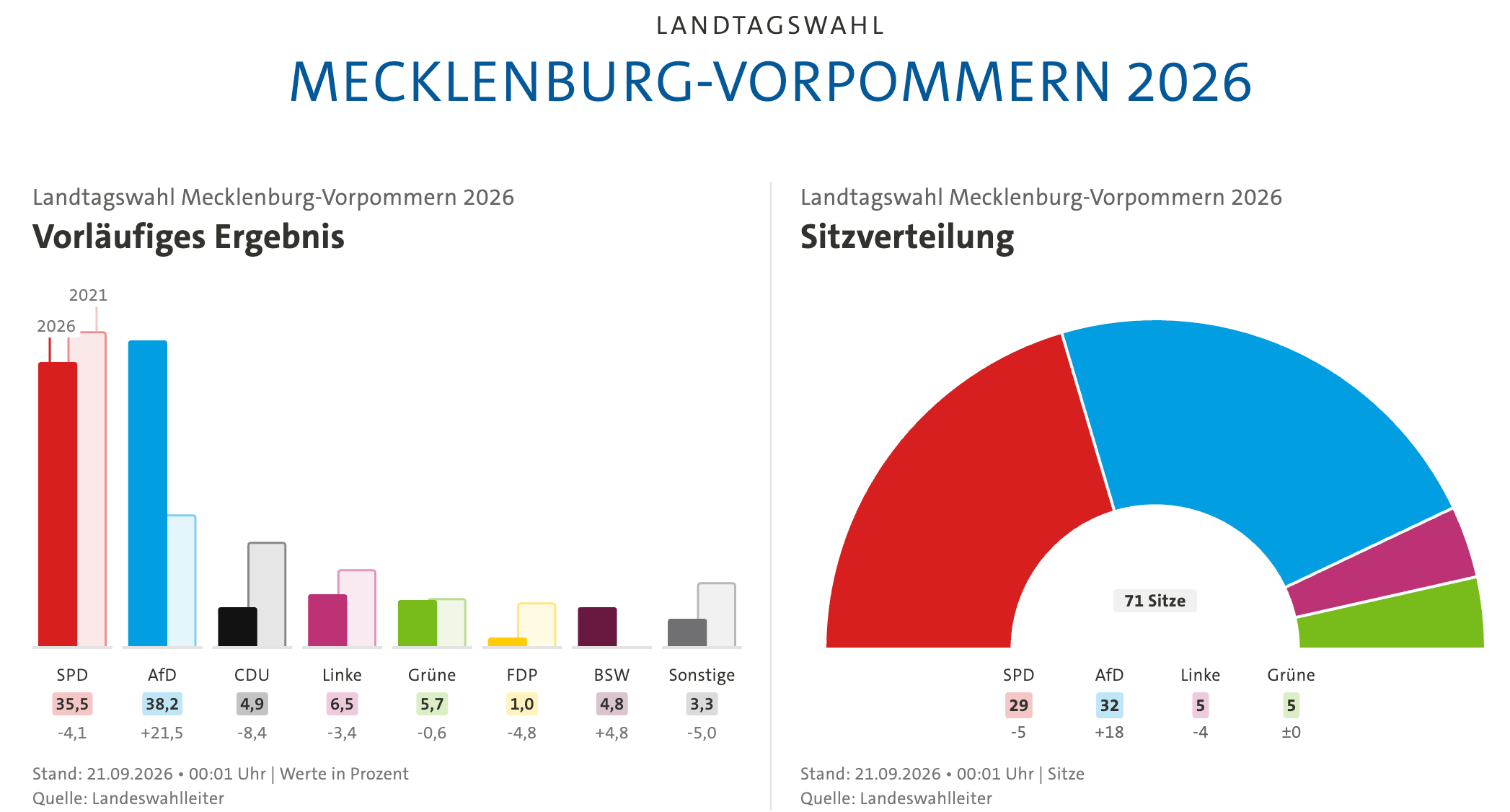
Alternative für Deutschland won the largest vote share, but the result will be another coalition of Social Democrats, Greens and Die Linke under the long-serving Minister President Manuela Schwesig. Schwesig enjoys especially strong popularity among women and pensioners, and she will be helped into power by a smattering of leftist students and climate-obsessed urbanites. The AfD will stand alone in opposition to the tepid foolishness of the coming legislature, and the citizens of Mecklenburg-Vorpommern will develop new ways of thinking about the Evil Fascist Nazi Hitler party, which probably cannot be all that evil or fascist or Nazi or Hitler, given that there is no longer any alternative to the left here in the northeast.
For ten years, the Union has borrowed the policies of left-of-centre parties and made them its own – bestowing Germany with the dumbest energy policy in the developed world and saddling its citizens with a deluge of unproductive, hostile and dependent foreigners from the global south. Then, Merz’s government made everything worse by caving to every last Social Democrat demand, essentially continuing Merkel’s political strategy but now in the absence of any conceivable political benefit.
There is no longer any reason to vote for the Union and in fact no reason for the Union to exist at all. The people who really want infinity migration and the energy transition can just cast their ballots for the leftist parties that developed and supported these crazy policies in the first place. People who don’t want infinity migration and the energy transition, meanwhile, have nowhere to go but Alternative für Deutschland. Merz’s incompetence at the federal level moreover means voters blame the CDU for the stagnant German economy and our creeping deindustrialisation. Worsening economic conditions have also hurt the Social Democrats, but not as much. Partly this is because, as in Sachsen-Anhalt, the left has shared votes among themselves to keep the SPD viable. Partly it is also because a bad economy has driven young voters to Die Linke, which is in turn happy to help the SPD into government.
The left has an entire mutually beneficial party ecosystem to manage discontent and to shuffle their perpetually disappointed voters around among themselves. The Union, in contrast, has actively fought against the emergence of rivals to their right and thus has been reduced to a mere vessel for leftist policies. The Union furthermore remains alone in its commitment to solving Germany’s problems “from the political middle,” while the leftist parties of this notional “middle” – the Social Democrats and the Greens – are happy to form coalitions with the fringe elements of Die Linke wherever the possibility arises. Any party so committed to its own asymmetrical disadvantage as is the Union must sooner or later cease to exist.
As the AfD wins elections and gains strength in East Germany, additional forces conspire against the hapless CDU, which has triangulated itself into defending a worthless political no-man’s land. The general agitation against the AfD and the fight “against the right” has the effect of turning every last state election into a referendum on national politics, and nationally the Union is mostly despised. The CDU have responded to these trends by jumping on the anti-AfD bandwagon, on the one hand insulting their own voters (many of whom harbour AfD sympathies) and on the other hand sparing to the left all serious criticism. Thus the Union cedes the AfD a total monopoly over the most valuable political real estate in Europe today, namely anti-leftism in all its forms – all while protecting and enabling the parties whose policies are slowly destroying them.
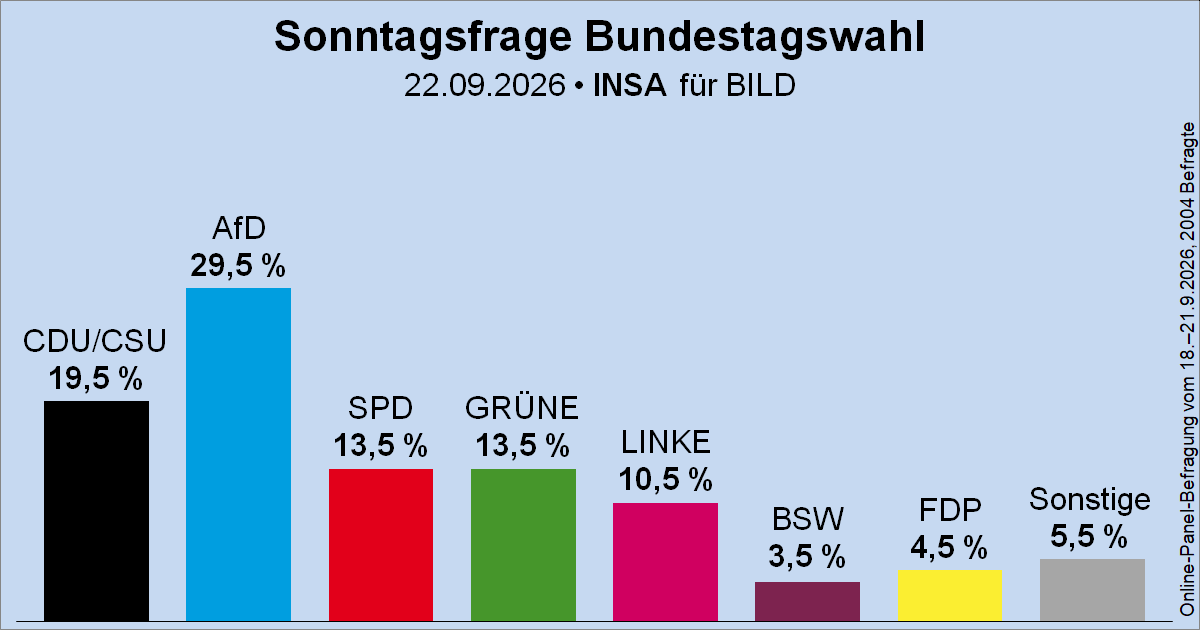
The reckoning is not over with, the disasters for the Union are still rolling in. The Social Democrats have now called into question Merz’s entire entitlements reform programme. Demands to oust Merz from the CDU party chairmanship have begun, and will grow louder. The latest national poll has the Union a record ten points behind the AfD:
How can he go on with no one behind him? I dislike the multiparty system, which resembles probably what I saw in Belgium. Even if AfD is the largest party they get blocked from government by a coalition of smaller parties, for which people did not really vote. And the mayor party cannot even deliver the governor/prime minister. My father once said that people should get the posts in order of their votes. Most votes gets to be prime minister, and so on. That would be democracy. What there is now is a hassle between politicians IMO
is Merzdämmerung how it would be said in Germany?