

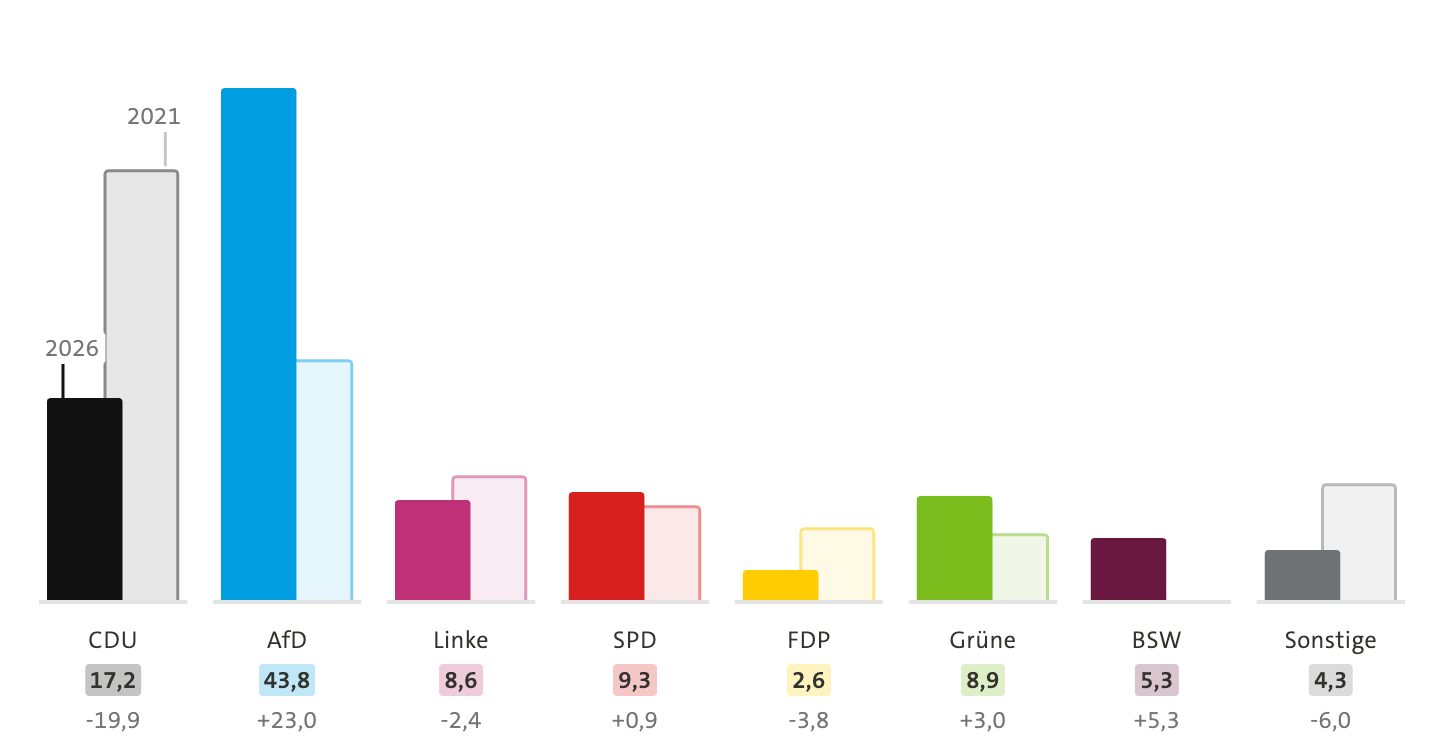
There will be some district-level recounts, some numbers might fluctuate slightly, but the preliminary results of Sunday’s cataclysmic election in Sachsen-Anhalt will not meaningfully change.
Alternative für Deutschland won 43.8% of the vote and 39 seats in the Landtag – just three short of an absolute majority. No party since reunification has ever performed this strongly in Sachsen-Anhalt before.
The CDU substantially underperformed polls and logged their worst-ever result in this state since 1990, with just 17.2% of the vote and 15 Landtag seats. It is an unmitigated and deeply deserved disaster for the hapless Union.
Die Linke/the Left Party, the Social Democrats and the Greens split the left vote more or less equally among themselves, after a (to me) unexpectedly successful tactical voting initiative. Each achieved eight seats with 8–9% of the vote – 24 seats in total for the entire left-party spectrum.
The old-left Linke-offshoot party Bündnis Sahra Wagenknecht (BSW) substantially outperformed polls with 5.3% of the vote and five Landtag seats.
What this means is simple: The AfD have no majority of their own, but the anti-AfD cartel parties (CDU, SPD and Greens) with their would-be collaborators in Die Linke do not have any majority against the AfD either. Both blocs stand against each other in effective stalemate with 39 votes each. This leaves the BSW as kingmakers, and the BSW have already ruled out the possibility of working with the CDU, and so all possibilities accrue to the AfD side of things. As I said on the night of the vote, Ulrich Siegmund’s repeated pledges to rule alone or not at all were a campaign strategy, and now they have also emerged as a negotiating tactic. Siegmund has established his willingness to walk away if the BSW do not give him what he wants.
As for what will happen now, it is easiest to imagine that the AfD and the BSW will reach some kind of understanding and that Ulrich Siegmund will be sworn in after procedural wrangling as the first AfD Minister President of the Federal Republic. There would be no formal coalition with the BSW, but rather a toleration arrangement with the AfD in a minority government.
Ironically, AfD strength has all but foreclosed the possibility that CDU defectors might elect Siegmund to the premiership without BSW support. Three such defectors would be required for a parliamentary majority, which would be fully one fifth of the minuscule CDU faction. That is already a hard ask, and it becomes a still harder one when you recognise that the tattered remnants of the Union returning to Magdeburg will be nothing but the most loyal party functionaries.
Everyone who matters – including the CDU – has ruled out the worst conceivable outcome, namely another anti-AfD firewall coalition under Union stewardship. Yet some variant of this scenario remains distantly possible, because the BSW continues to voice its idiotic preference for a “cross-party” Minister President, and – as I said above – Siegmund might just walk away and refuse to stand for the top office at all. The “cross-party” premier would be a magical somebody voted into office either a) by everyone but the AfD, or b) by the BSW and the AfD together. In the former variant, this Minister President would have no clear mandate and no consistent majority for any conceivable agenda. In the latter variant, the AfD would propose some figurehead Minister President, the BSW would cosign it, and this figurehead would then fill his cabinet with AfD and BSW ministers.
Yes, that is as dumb as it sounds, but there’s maybe only a one-in-twenty chance that it comes to that. There’s not much fight left in the cartel parties of Sachsen-Anhalt. Multiple prominent CDU figures, including failed Union lead candidate Sven Schulze, have said the CDU should go into opposition in Sachsen-Anahlt, and Schulze has acknowledged that voters have given the Regierungsauftrag (the responsibility of forming a government) to Siegmund’s AfD.
In other amusing developments:
Chancellor Friedrich Merz and Sven Schulze gave a shell-shocked press conference yesterday.
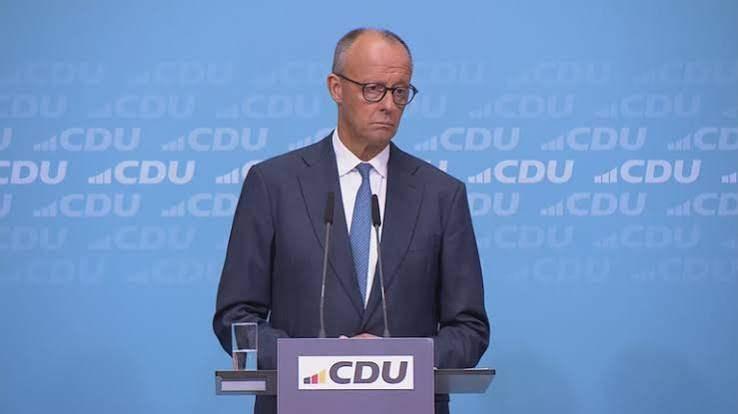
Merz in particular seemed surprised at the Sachsen-Anhalt result. “We are all deeply shocked,” he said, “we did not expect it to happen like this.” This must raise serious questions about Merz’s information environment, given that the outcome of the Sunday vote has been eminently predictable for months. Merz further asked himself “how things could have come to this” and confided that he is “looking for the reasons within myself too” – acknowledging that his own controversies have been a constant theme in this year’s elections. As has become customary for failed politicians, Merz ultimately concluded that he needs to communicate better, but then upon realising that this is a shopworn cliché he added bizarrely that he must “try to connect with people more deeply on an emotional level,” because that will make everything better.
For some reason the firewall against the AfD is no longer the flavour of the month within the Union. Angela Merkel, once its staunchest enforcer, just today said that “I didn’t come up with it and I don’t particularly like it either.” Boris Rhein, CDU Minister President of Hessen, has called the Brandmauer “the wrongest path,” declaring with newfound democratic sentiment that his party should “talk to everyone, talk about everything, build bridges to the centre and not push people beyond firewalls.” This shift in sentiment is to be expected, as Unioners realise that they and not the AfD are the ones whom the firewall will shut out of government.
Naturally, not everybody is equally introspective. Arch-Merkelian Hendrik Wüst, CDU press favourite and Minister President of Nordrhein-Westphalen, has developed a new interest in banning the AfD, calling for a federal and state “working group” to look into this possibility.
The Turkish Association in Germany has declared that Sunday’s AfD victory means that all migrants in Sachsen-Anhalt face serious danger. Our hysterical activists have demanded that the government cease sending asylum seekers to Sachsen-Anhalt and also release all refugees presently in that state from their residence requirements. This follows earlier warnings from an advocacy organisation that as many as 80% of migrants in Sachsen-Anahlt might leave the state should the AfD enter government there.
difficult to imagine a stronger incentive to vote AfD than promising “any state that votes AfD will lose nearly all its migrants to the other states”
prisoner’s game: lightspeed defection edition
Now they will put their thumbs on the scale in every way they can, while continuing to ignore the reason that AfD is winning in the first place.
You have to wonder why so many governments around the world are willing to commit political suicide in order to import millions of illegal immigrants, all without a single actual vote on the issue.