

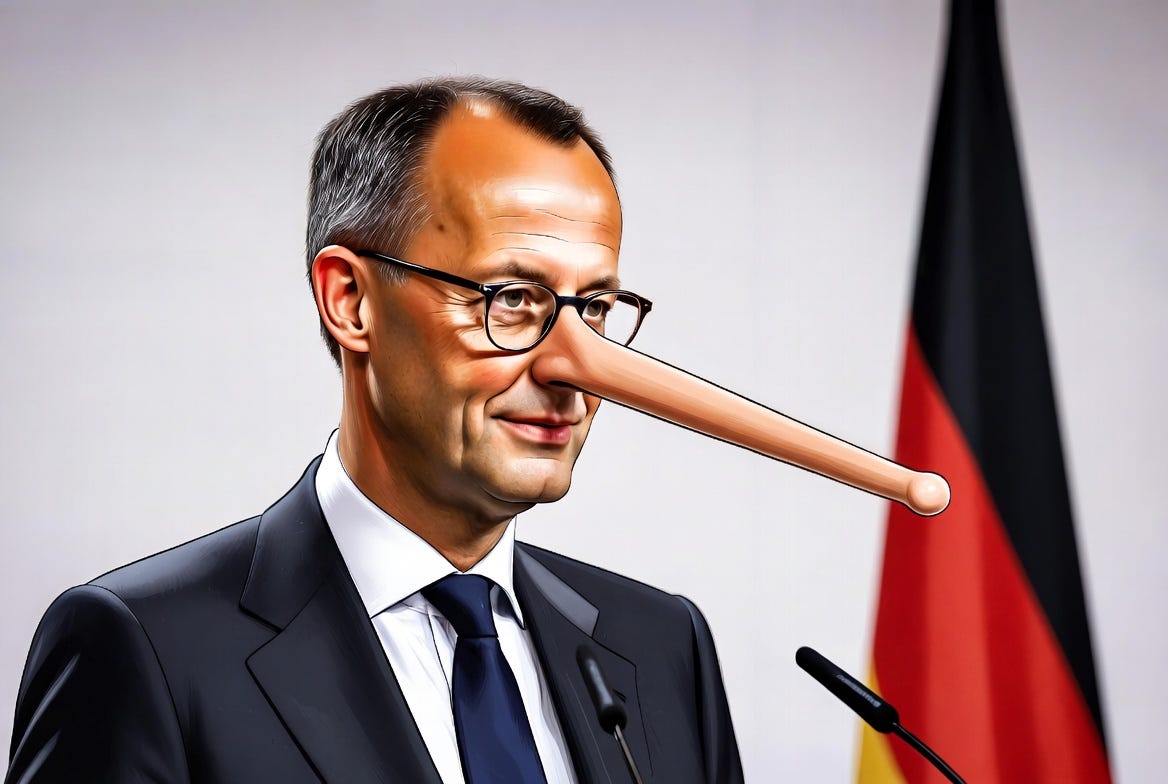
In the latest retarded case of political repression to afflict the Federal Republic of Germany, police are investigating a pensioner for the crime of associating the German Chancellor with an iconic children’s book character.
When … Friedrich Merz and Baden-Württemberg Minister President Winfried Kretschmann came to Heilbronn last October for the opening ceremony of the Innovation Park Artificial Intelligence (IPAI), the celebrity visit occasioned discussion discussion on social media.
A post appeared on the Heilbronn Police Facebook page informing locals about a temporary flight ban enacted for security during the visit. A resident of Heilbronn responded by writing that “Pinocchio is coming to [Heilbronn].” He included a long-nosed emoji.
Three months later, at the end of January, the man could hardly believe his eyes as he received a letter from the criminal police informing him that he is now under investigation for his comment. He is suspected of committing the crime of insult as prohibited by Section 188 of the Criminal Code.
StGB §188 is the notorious “lèse-majesté” statute, which the Bundestag expanded substantially in 2021 when politicians grew tired of being criticised for suspending most of our democratic freedoms in a mad drive to exterminate a respiratory virus. As currently formulated, StGB §188 enhances penalties for “insult, malicious gossip and defamation” when the rabble direct these at “persons in political life,” and also makes these transgressions easier to prosecute. In this case, the pinched schoolmarms on the “social media team” who run the Heilbronn Police Facebook page filed a complaint with prosecutors as soon as they noticed our pensioner’s comment. Apparently it is their policy to monitor comments and cry to teacher whenever they see anything they don’t like.
What makes this investigation particularly egregious – as the Heilbronner Stimme notes – is the fact that comparing Merz to “Pinocchio” is widespread in German political discourse, for the simple reason that Merz has reversed himself more than any other national politician in recent memory. Last year, Green Party Chair Franziska Brantner warned Merz against “becoming the Pinocchio Chancellor” after he reversed his promise to reduce electricity taxes on private households, and AfD Bundestag member Stephan Brandner called Merz “Pinocchio Fritze” when the latter violated his campaign pledge not to raise the debt brake. Brandner made his comments under the veil of immunity on the floor of the Bundestag, but he also posted an Instagram photomontage “depicting Merz with a Pinocchio hat and a long nose.” Google searches reveal dozens of further examples from commentators, satirists and ordinary people all across the internet.
Likening Merz to Pinocchio hardly constitutes an insult even under the extremely vague and broad wording of the German criminal code. The investigation in this case is a simple effort to intimidate an ordinary German citizen for political speech that even our weak Article 5 speech protections clearly shield. What is more, the original Facebook post to which our pensioner replied mentioned Winfried Kretschmann alongside Chancellor Merz. Strictly speaking, the Pinocchio comment could apply to either person, and the only reason our social media hall monitors associated Merz with the allusion is because they too recognise that the man is a liar.
German speech repression has eased in the past months, probably due to political pressure from the United States and a growing realisation that these cases make our authorities look immensely stupid. In the case, the numpties in Heilbronn appear not to have gotten the memo.
Well, in the end Pinocchio became a real boy - perhaps Herr Merz may become a real man and stop this crazy persecution in its tracks.
The very special German politicians need to look at the robustness of political discourse in Anglophone nations. It's only in Germany where there is a special assumption that politicians are thin-skinned and fragile. Elsewhere, you put yourself in the public eye you are expected to put up with a much higher degree of ridicule. Not a lower degree.