

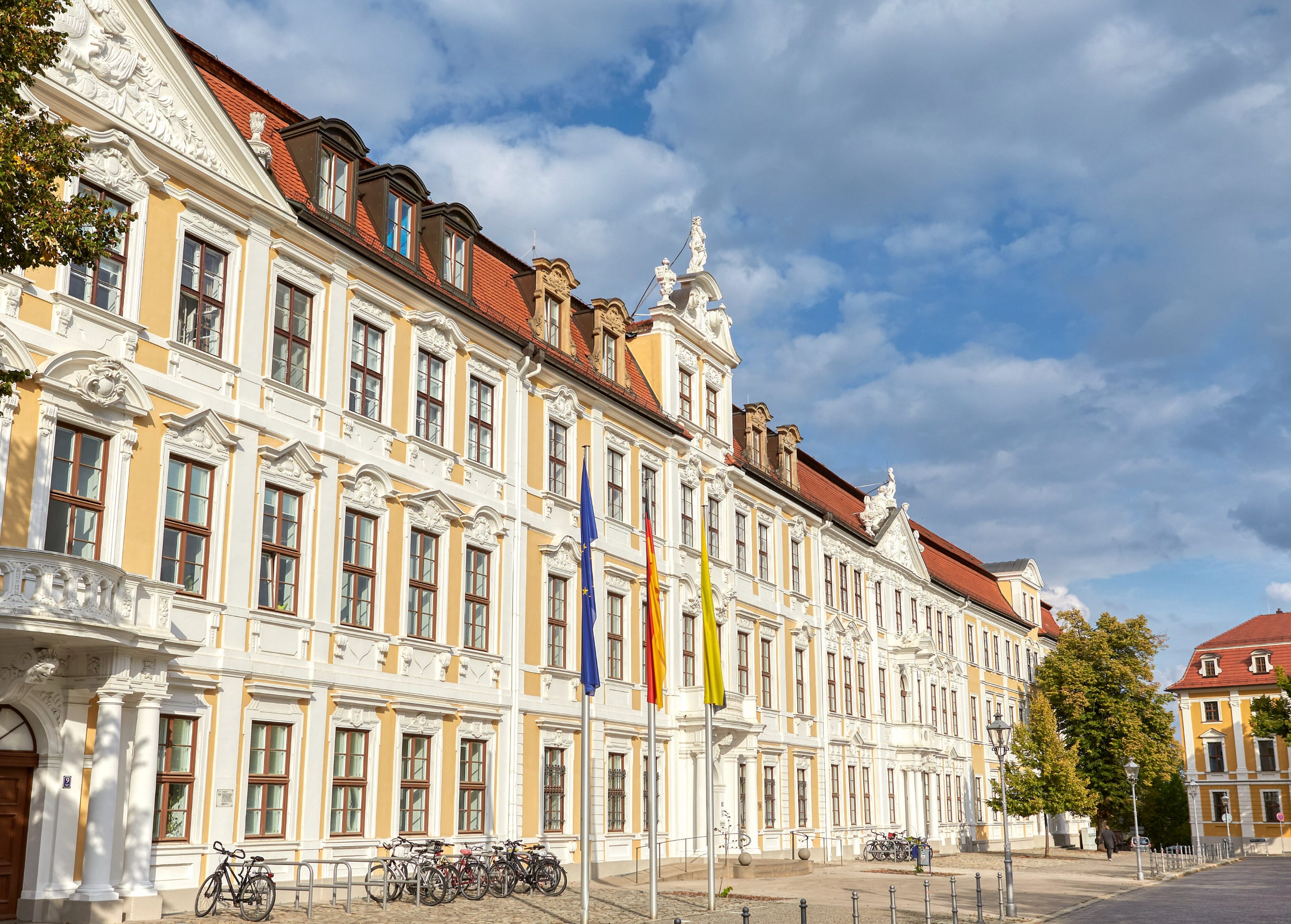
On 6 September – in less than two months – the citizens of Sachsen-Anhalt will elect a new state parliament. This is a problem for Our Democracy Enjoyers, because Sachsen-Anhalt is in East Germany, and Alternative für Deutschland are especially strong there. According to polls, the AfD are on the verge of winning an outright majority of Landtag seats. In this case the firewall would not matter at all; the AfD could govern alone without any partners. Should the AfD fall short, they will nevertheless fall very slightly short, perhaps just one or two seats short of a majority. Right now both outcomes look equally probable.
The powers that be don’t want to see the AfD in charge of Sachsen-Anhalt. One reason is that an AfD government would have the full run of the Interior Ministry and of the State Office for the Protection of the Constitution. Suddenly the political opposition would learn about all the dirty hyperdemocratic tricks the cartel parties have gotten up to these past years to defend Our Democracy. Another reason is that an AfD government could theoretically terminate the state broadcasting agreements behind German public media, which would be really ungood because Our Democracy requires a constant stream of propaganda funded by mandatory licensing fees even to work. Still another reason is that an AfD majority government would be disinclined to treat the newly minoritised parties with all that much fairness or consideration, given how little fairness and consideration the AfD itself has received the past ten years; and a final reason is that when people realise an AfD government does not warp time and return us immediately to 1933, the party will experience some degree of normalisation in public perception.
Naturally, all these reasons (except for perhaps the first) reflect the variously exaggerated fears of a political cartel slowly losing its hold on power. German public media is too entrenched for a single hostile state government to uproot, the chances the AfD even tries to use the judiciary to hunt down its political opponents are less than zero, and it is far from clear the AfD would benefit electorally or in terms of popularity from presence in government. Normalisation is a knife that cuts both ways.
The other possibility – an AfD win that lands the Evil Nazi Hitler Fascists a few seats short of a majority – might actually be worse for the establishment, or at least for the CDU. The only way the Union could form a government in this scenario, would be with support from the lapsed communists of Die Linke – a toxic prospect particularly for older, conservative CDU voters in East Germany. Either the AfD wins everything, or the CDU gets a chance to lose even more catastrophically and in greater detail than heretofore contemplated. That’s what at stake in Sachsen-Anhalt.
Today, Focus reports the fears of two anonymous sources (“one of them in the CDU parliamentary group”) that the resulting pressure could split the Union. Specifically, they contemplate a post-election scenario in which a minority faction aims to forestall any arrangement with Die Linke by defecting from the CDU to help the AfD into government. Apparently, the Sachsen-Anhalt CDU is working actively to forestall just such a catastrophe, above all by purging party lists of internal critics and mavericks. Fully 14 right-leaning CDU MPs currently in the Sachsen-Anhalt parliament will not be returning as list candidates.1 To maintain discipline in the face of the AfD threat, in other words, the Sachsen-Anhalt CDU has taken steps to move its parliamentary group substantially to the left and increase its compatibility with the ex-Communists of the Die Linke/ the Left Party.
Die Linke, for their part, are just as eager to make common cause with the CDU. On Sunday, somebody leaked an internal strategy paper from Die Linke in Sachsen-Anhalt to BILD. In this document, our once-and-future Socialist Unity Party lays out their plans to help the CDU into government should the AfD fails to win outright. They fear that withholding support from the Union would trigger special parliamentary procedures that would in turn make the election of an AfD Minister President much more likely. Intriguingly, Die Linke’s strategists also speculate about what would happen if the CDU attempted any rapprochement with the AfD. They imagine that this would split the CDU into a “middle-right” and a “right-conservative” party, the latter of which would cooperate with the AfD and make all parties to the left of them irrelevant. It might also bring down the federal government, but, details.
It turns out that a firewall against a powerful populist party works like a perverse machine to drive everyone else away from the politics voters actually want, in this way reinforcing the firewall and the strength of the populist party on the other side of it. In these moments of fear and loathing, discontents within the CDU fear that any deals with Die Linke will split their party, while Die Linke suggests that any attempt by the CDU to work with the AfD will do the same. The CDU themselves, meanwhile, deploy only short-term tactics against the immediate crisis, at the cost of ever greater crises the next time somebody goes to the ballot box. The best outcome for the Union is total AfD victory, while the AfD would arguably benefit (electorally at least) from another legislative term out of government.
Our Democracy has to be the most retarded political system anybody has ever devised.
For those not versed in the ways of Our Democracy, a brief primer: Germany has a hybrid system in which everybody actually gets two votes. You cast the first for a specific candidate in your electoral district, you cast the second for a party. Generally speaking, the winners of the district elections go to parliament with direct mandates. The rest of the parliamentary seats are filled from party lists, such that the ultimate makeup of the parliament approximates the distribution of the second, party-level ballots. The parties themselves control who gets placed on their lists and in which order they end up there. The AfD are so powerful in Sachsen-Anhalt that the CDU are unlikely to win any direct mandates at all. Perversely, this weakness gives the CDU itself more prerogative to determine the makeup of the entire parliamentary group.
In my last post, some AI-fuelled Substack novelty featured decided it would be fun to hide various replies and to locate these hidden replies under a special "Hidden Replies" menu, thereby highlighting them. I didn't know this feature existed and I've disabled it.
All throughout the West it is the same conversation over and over.
“Why won’t these angry voters just go away already?”
“Have you tried addressing the issues we are angry about yet?”
“No, we don’t think you have any right to be angry.”
“Then we are not going away!”